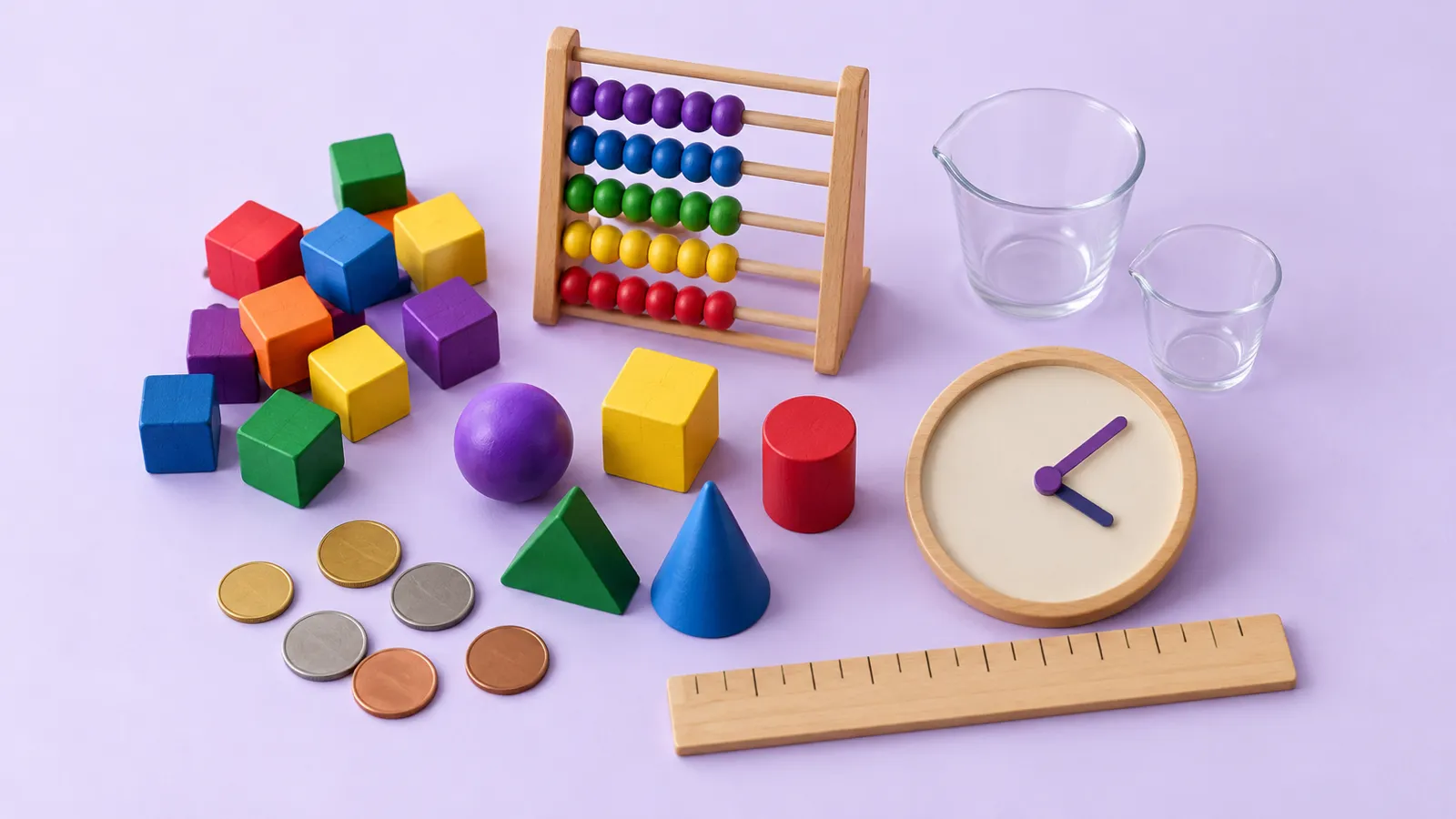
Money Activities for Kindergarten and 1st Grade (Coins, Counting, Pretend Store)
Young children learn money best by touching and using coins. In kindergarten, focus on identifying pennies, nickels, dimes and quarters by their features and sorting them. In 1st grade, add coin values and counting collections of pennies, nickels and dimes by skip counting. Use coin sorting, coin riddles, piggy bank roll-and-add games and a classroom pretend store. The Common Core places counting money in 2nd grade, but many states and programs introduce coins earlier, so check your state standards.
In this article you will find
Kindergarteners and 1st graders learn money best by handling coins: sorting pennies, nickels, dimes and quarters by their features, then (in 1st grade) learning each coin’s value and counting small collections by skip counting, with plenty of play in a classroom pretend store. Money is concrete, familiar and motivating, but it’s also tricky: a dime is smaller than a nickel yet worth more, and counting mixed coins means switching between counting by 10s, 5s and 1s. The activities below move from identifying coins to counting them, with ideas you can run as whole-class lessons, centers or a week-long store. For how money connects to the rest of early math, see our elementary math guide.
What the standards say
Expectations vary by state. The Common Core places money in 2nd grade, with word problems involving dollar bills, quarters, dimes, nickels and pennies using the $ and ¢ symbols. Many states, however, include identifying coins in kindergarten or 1st grade, and some include counting small collections of coins in 1st grade. Check your state standards and use the activities that match. Even where money isn’t a formal standard in K–1, coins are excellent tools for counting, sorting and skip counting, which are.
Before you start: real coins or realistic ones?
Real coins are best for noticing details, like the ridges on a dime’s edge or the faces on each coin. Many teachers keep a small bag of real coins for close observation and use realistic plastic or printed coins for games. Avoid cartoon coins that don’t look like the real thing; children need to recognize the coins they’ll actually see. Supervise closely in kindergarten, since coins are a choking hazard.
Kindergarten: noticing and naming coins
Coin detectives. Give each table a magnifying glass and one of each coin. Children describe what they see: color, size, the picture on each side, smooth or bumpy edge. Record their words on a chart under each coin. This slow look is the foundation for everything else.
Coin sort. Children sort a pile of mixed coins into four cups or mats with a picture of each coin’s front and back. Then ask: “How did you know that was a dime?” Accept answers about size, color and edges.
Coin rubbings. Place coins under thin paper and rub with the side of a crayon. Children label each rubbing with the coin’s name. It’s a quiet center that reinforces details.
Coin riddles. “I’m brown. I’m the only coin that isn’t silver. What am I?” “I’m the smallest coin, and my edge is bumpy.” Children hold up the matching coin. Then they make up riddles for each other.
Coin songs and chants. A short chant that names each coin and one feature helps memory. Keep it simple and say it during transitions.
Heads or tails graph. Each child flips a coin ten times and colors a bar for heads or tails. It’s a fun way to combine coins with data.
1st grade: values and counting
Coin value match. Cards with coins and cards with values (1¢, 5¢, 10¢, 25¢). Children play memory, matching each coin to its value. Emphasize: “The dime is small, but it’s worth 10 cents.”
Skip counting with coins. Line up dimes and count by 10s: 10, 20, 30. Line up nickels and count by 5s. Then pennies by 1s. Practice each pattern before mixing coins.
Count the collection. Give a small bag of dimes, nickels and pennies (no more than 6 or 7 coins). Children sort the coins from greatest value to least, then count on: “10, 20, 25, 30, 31, 32 cents.” Start with only two coin types and add the third later.
Piggy bank roll and add. Each child has a paper piggy bank. They roll a die and take that many pennies. When they have five pennies, they trade for a nickel; two nickels trade for a dime. The first to reach a set amount, such as 30¢, wins. Trading teaches equivalence the way base-ten trading teaches place value.
Show it two ways. Children show 10¢ in two ways: one dime or two nickels or ten pennies. Then 15¢, 20¢ and 25¢. Older 1st graders can find all the ways to make 25¢ with dimes and nickels.
Coin number line. Children jump along a number line from 0 to 50, making jumps of 10 for each dime and 5 for each nickel. It connects coin counting to skip counting on the number line.
The classroom pretend store
A pretend store is the activity children remember most, and it practices everything at once: naming coins, finding values, counting and making change in simple cases.
Setup. Use empty food boxes, toys or classroom items. Label each item with a price that matches your students’ level: 1¢ to 10¢ for kindergarten, 5¢ to 50¢ for 1st grade. Give each shopper a coin purse with a set amount.
Roles. One or two children are cashiers, the rest are shoppers. Rotate roles every 10 minutes. Cashiers check that the coins match the price.
Shopping lists. Shoppers get a short list or choose items, find the total and pay. For 1st grade, add a challenge card: “Buy two things. How much did you spend?”
Recording. Shoppers draw the coins they used for each item on a simple receipt sheet. This turns play into evidence you can check.
Keep it running. Leave the store open as a center for a week or two, changing prices or adding a “sale” to keep it fresh.
Using money activities in centers
Many of these activities fit naturally into math centers: coin sort, coin rubbings, value match, piggy bank game and the store. Our post on kindergarten math centers has more center ideas by skill that pair well with money.
Common confusions
Size and value. Children assume bigger coins are worth more. Address it directly: put a nickel and a dime side by side and ask which is worth more, then prove it with pennies.
Counting coins as ones. A child counts three dimes as “3 cents.” Practice “touch and count by 10s” with dimes alone before mixing.
Switching counting patterns. Counting 10, 20, 25, 26 is hard. Start with the coin of greatest value, use a number line or hundred chart and give lots of practice with two coin types first.
Quarters. Counting by 25s is hard in 1st grade. If your standards include quarters, focus on identifying them and knowing their value rather than counting collections with them.
Connecting money to other skills
Money links to time (both are 2nd grade measurement standards in the Common Core), place value (trading ten pennies for a dime mirrors ten ones for a ten) and addition. Our post on telling time activities for 1st and 2nd grade has a sequence you can run alongside money in the spring.
Supporting all learners
Use larger realistic coins or coin cards for children who have trouble handling small objects. Follow accommodations in IEPs or 504 plans as decided by the team, such as a coin value chart during practice. For English learners, pair each coin’s name with a picture and use sentence frames: “This is a ___. It is worth ___ cents.” Be mindful that families have different experiences with money; keep activities playful and avoid asking about spending or saving at home.
Prep in less time
Coin cards, store price tags, riddle sheets and counting pages at different levels take time to make. An AI worksheet tool can draft coin counting pages with the coins and amounts you choose, and you check the pictures and totals before printing.
Money is one of the most practical topics in early math. For more K–5 skills and how they build on each other, visit our elementary math guide.
FAQ
When do kids learn about money in school?
It depends on the state. The Common Core includes money word problems with bills and coins in 2nd grade, while many state standards and programs introduce coin identification in kindergarten or 1st grade. Check your state's standards for the exact expectations.
How do you teach coins to kindergarten?
Start with real or realistic coins. Let children look closely, describe color, size and edges, and sort them. Teach names before values, and use songs, riddles and sorting games rather than worksheets.
Why is counting coins hard for young children?
Coin size doesn't match value: a dime is smaller than a penny and a nickel but worth more. Children also need to skip count by 5s and 10s and switch between counting patterns, which takes practice.
Read next
Math
Fraction Activities for 3rd Grade: Hands-On, Number Line and Equivalent Fractions
 Math
Math Fact Fluency Games: 20 Ideas for Addition, Subtraction and Multiplication
Math
Multiplication Facts Strategies for 3rd Grade: The Order to Teach + Games
Math
Place Value Activities for 2nd Grade (with 1st and 3rd Grade Variations)
 Holidays
Gingerbread Man Activities for Kindergarten and 1st Grade (Literacy, Math, STEM)
 Special Education
Kindergarten IEP Goals: Reading, Math, Writing and Behavior Examples