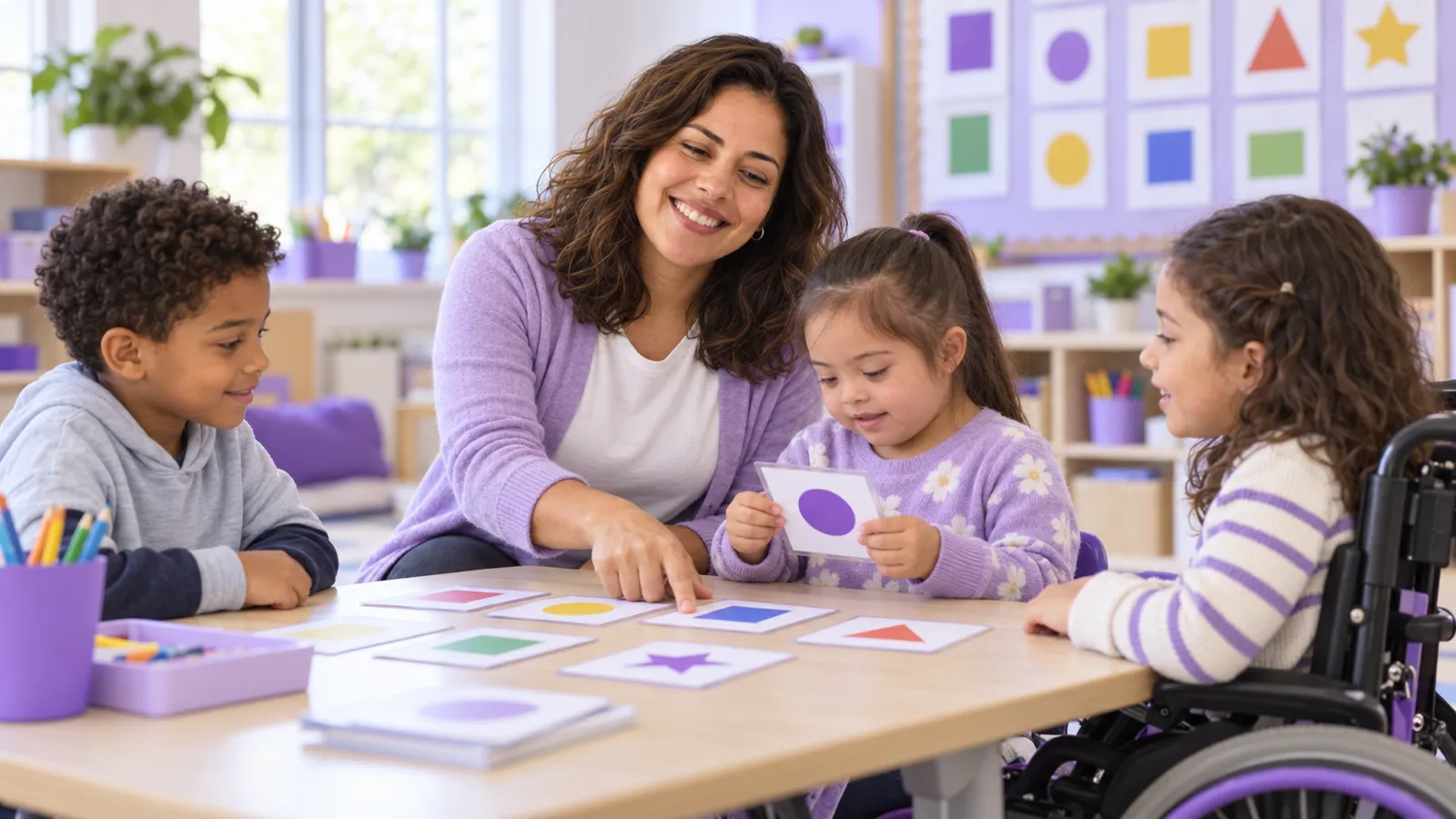
Kindergarten IEP Goals: Reading, Math, Writing and Behavior Examples
Kindergarten IEP goals should target the foundational skills of the grade, such as letter sounds, phonemic awareness, counting and number sense, early writing, following routines and self-regulation, and be written so progress can be measured often. Each goal needs a baseline from present levels, a specific observable skill, conditions and supports, a criterion and a timeline. Because kindergarten skills change fast, goals often work best with short benchmarks and frequent, play-based checks. Examples for reading, math, writing, behavior and communication are below; the IEP team decides the final goals with the family.
In this article you will find
- What a kindergarten goal needs
- How kindergarten goals differ from preschool goals
- Reading goals
- Math goals
- Writing goals
- Behavior and self-regulation goals
- Communication and social goals
- Setting baselines in kindergarten
- Tracking progress
- Common mistakes with kindergarten goals
- Working with families
- Privacy
- Draft goals faster
Kindergarten IEP goals should target the foundational skills of the grade, such as letter sounds, phonemic awareness, counting and number sense, early writing, following routines and self-regulation, and be written so that progress can be measured often. Kindergarten is a year of fast growth, so goals work best when they are specific, built from a clear baseline and checked with quick, play-based probes. Below are measurable examples for reading, math, writing, behavior and communication, along with tips for setting baselines and tracking progress. Every goal is a starting point; the IEP team, including the family, decides the final goals based on the student’s evaluation and needs.
What a kindergarten goal needs
Each goal should include:
- Baseline: what the student can do now, from the present levels. “Currently identifies 6 of 26 letter sounds.”
- Skill: an observable behavior. “Will say the most common sound for each letter.”
- Conditions: when and with what support. “When shown lowercase letter cards in random order.”
- Criterion: how well. “For 20 of 26 letters.”
- Measurement and timeline: how often and by when. “On two consecutive probes, by the annual review.”
For the full method, see our guide on how to write IEP goals.
How kindergarten goals differ from preschool goals
Preschool IEP goals usually focus on developmental areas: play, early communication, motor skills and self-help. In kindergarten, goals connect more directly to grade-level academic standards, such as knowing letter sounds and counting to 100, while still addressing developmental needs. If a student is moving up from an early childhood program, review their previous goals together with the IEP goals for preschool to see what carries over.
Reading goals
Letter-sound knowledge: By the annual review, when shown 26 lowercase letters in random order, the student will say the most common sound for at least 20 letters on two consecutive biweekly probes. (Baseline: 6 sounds.)
Letter names: Given uppercase and lowercase letter cards, the student will name 40 of 52 letters with 90% accuracy across three consecutive probes. (Baseline: 15 letters.)
Phonemic awareness, first sounds: When given a spoken one-syllable word, the student will say the first sound in 8 out of 10 words across three consecutive sessions. (Baseline: 3 out of 10.)
Blending: When the teacher says three separate sounds, the student will blend them into a word (such as /m/ /a/ /p/ to map) in 8 out of 10 trials across three sessions.
Reading CVC words: Given a list of 10 decodable CVC words, the student will read at least 8 words correctly by blending sounds on two consecutive probes.
High-frequency words: The student will read 20 high-frequency words from the kindergarten list with 90% accuracy across three consecutive probes.
Math goals
Counting: The student will count aloud by ones from 1 to 50 without errors on three consecutive probes. (Baseline: counts to 12.)
One-to-one correspondence: Given a set of up to 10 objects, the student will touch and count each object once and say how many in 4 out of 5 trials.
Number recognition: The student will identify written numerals 0 to 20 shown in random order with 90% accuracy across three consecutive probes.
Comparing: Given two groups of up to 10 objects, the student will identify which group has more or fewer in 4 out of 5 trials.
Addition and subtraction within 5: Using objects or drawings, the student will solve addition and subtraction story problems within 5 in 4 out of 5 problems across three sessions.
Writing goals
Letter formation: The student will write 20 of 26 lowercase letters legibly from dictation on two consecutive probes. (Baseline: writes 5 letters.)
Writing their name: The student will write their first name with correctly formed letters, starting with a capital, independently in 4 out of 5 opportunities.
Spelling with sounds: When given a spoken CVC word, the student will write at least the first and last sounds in 8 out of 10 words across three sessions.
Sentence writing: Given a picture prompt and a sentence frame, the student will write a sentence of at least three words with a capital and a period in 4 out of 5 writing samples.
Behavior and self-regulation goals
Following routines: Using a visual schedule, the student will move to the next activity within 1 minute of the transition signal in 8 out of 10 transitions per day for 4 consecutive weeks. (Baseline: 3 out of 10.)
Staying with the group: During whole-group lessons of up to 15 minutes, the student will remain in their assigned spot and participate with no more than two prompts in 4 out of 5 lessons.
Using a calm-down strategy: When frustrated, the student will use a taught strategy (break card, breathing, calm corner) instead of hitting or throwing objects in 4 out of 5 observed incidents across four weeks.
Following directions: The student will follow a one-step direction given to the group within 10 seconds in 8 out of 10 opportunities across three days.
For more behavior examples and ways to measure them, see our IEP goals for behavior.
Communication and social goals
Requesting: The student will use a three-word phrase or a device message to request items or help during centers in 4 out of 5 opportunities across three sessions.
Turn-taking: During a structured game with one peer, the student will take turns for at least 4 exchanges with no more than one adult prompt in 4 out of 5 sessions.
Answering questions: After a read-aloud, the student will answer simple who and what questions about the story in 4 out of 5 questions using words, pictures or a device.
Autistic kindergarteners often have goals in these areas, coordinated with the speech-language pathologist.
Setting baselines in kindergarten
Kindergarteners often perform differently depending on the day, the adult and the setting. To get a reliable baseline:
- Collect data on at least three separate days.
- Use the same materials and directions each time.
- Make the check feel like a game, with short tasks of 2 to 3 minutes.
- Note any supports used, such as pointing, modeling or a visual.
Tracking progress
Check each goal at least every two weeks with a short probe. Plot the results on a simple graph so the team and family can see the trend. If progress is flat for three or four data points, talk with the team about adjusting instruction, not just waiting for the annual review.
| Goal area | Quick probe |
|---|---|
| Letter sounds | Flash cards, random order, 2 minutes |
| Blending | 10 oral words with three sounds |
| Counting | Count aloud from 1, note the highest number |
| Writing | Dictate 5 letters or 3 CVC words |
| Behavior | Tally transitions or incidents during one routine |
Common mistakes with kindergarten goals
- Goals copied from the standards. “Will know all letter sounds” restates the standard but doesn’t fit a student who knows four. Start from the baseline and set an ambitious but reachable target.
- Too many goals. A kindergartener with ten goals gets only a few minutes on each. Focus on the needs that block the most learning.
- Vague behavior words. “Will behave appropriately” can’t be measured. Name the behavior: “will stay in the group area,” “will use a break card.”
- Criteria that can’t be checked in kindergarten. Long written tests don’t work at 5. Choose criteria you can measure with short, hands-on probes.
Working with families
Share goals in plain language and give families one or two ways to practice at home, such as saying letter sounds on signs or counting snacks. Ask what they see at home, especially for behavior and communication. Families’ observations often help the team set realistic, meaningful goals.
Privacy
IEP documents, data and evaluation results are education records protected under FERPA. Keep them in school-approved systems and share them only with staff who need them.
Draft goals faster
Turning observations into measurable goals for several students takes time. An AI IEP goal draft assistant can draft goals from your notes on present levels, with conditions and criteria, and the team reviews, edits and decides on each one.
For goals across reading, math, writing, behavior and more, visit our full IEP goal bank.
FAQ
What are good IEP goals for kindergarten?
Goals that target the student's biggest needs in foundational skills: identifying letter sounds, blending and segmenting sounds, counting and comparing numbers, writing letters and simple words, following classroom routines and managing frustration. Each should be measurable and based on a baseline.
How are kindergarten IEP goals different from preschool goals?
Kindergarten goals connect more directly to grade-level academic standards, such as letter-sound knowledge and counting to 100, while preschool goals focus more on developmental skills like play, communication and early self-help.
How do you measure IEP goals in kindergarten?
Use short, frequent, game-like checks: a letter-sound probe with flash cards, a counting task with objects, a writing sample or a behavior tally during a routine. Record results on a simple data sheet at least every two weeks.
Can a kindergartener have IEP goals for behavior?
Yes, if behavior affects learning and the team identifies it as a need. Goals often focus on following routines, transitions, staying with a group and using a calm-down strategy.
Read next
 Special Education
Preschool IEP Goals: Social, Communication, Adaptive and Pre-Academic Examples
Special Education
Math IEP Goals: 40 Measurable Examples (K–5)
 Special Education
IEP Goals for Reading Comprehension (1st–5th Grade Examples)
Special Education
IEP Goals for Reading Fluency by Grade (with WCPM Benchmarks)
 Math
Division Anchor Charts: Vocabulary, Strategies and Long Division (3rd–5th)
Math
Fractions Anchor Charts for 2nd–5th Grade: What to Put on Each One