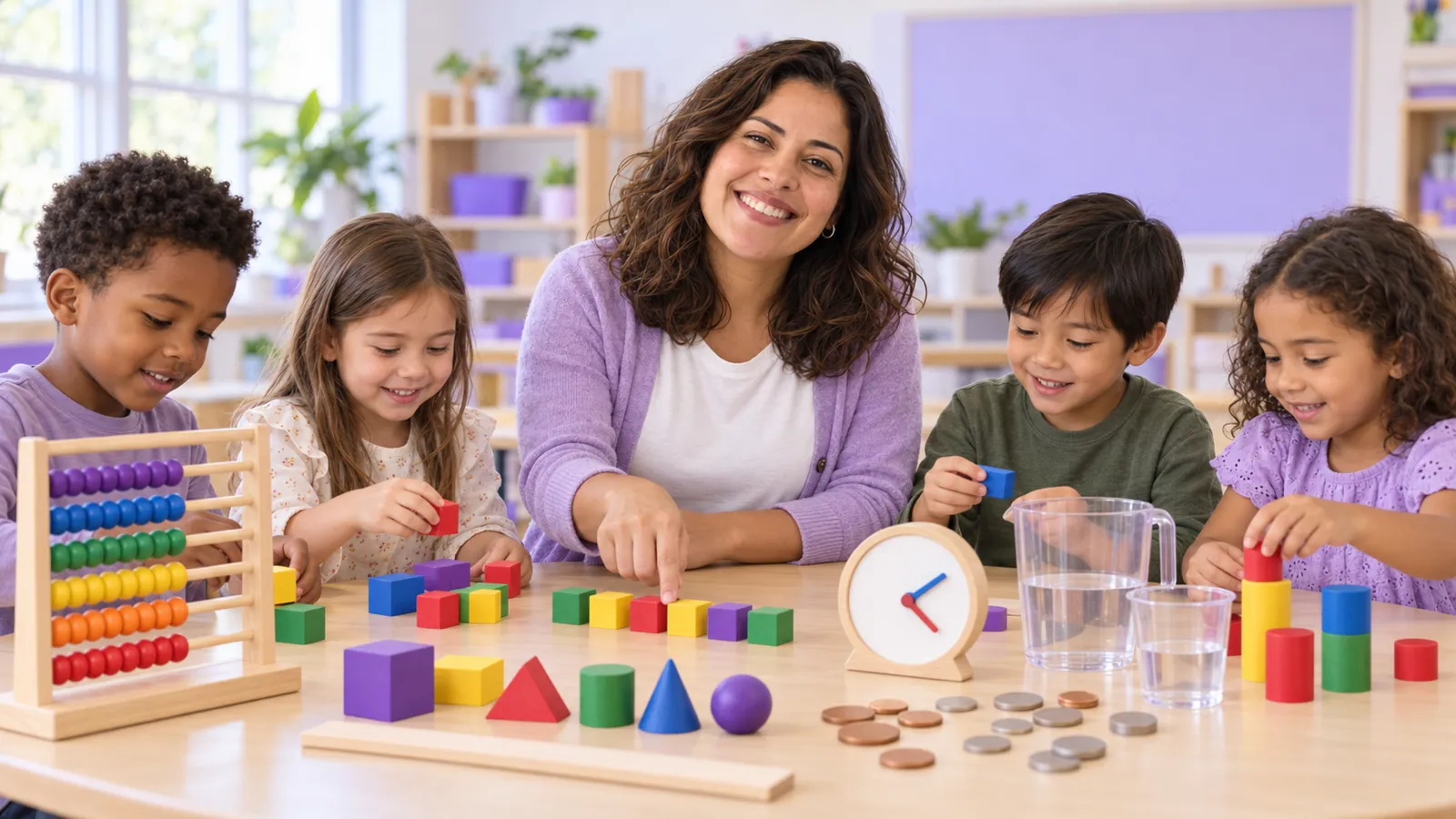
Telling Time Activities for 1st and 2nd Grade (Hour, Half Hour, 5 Minutes)
First graders tell and write time to the hour and half hour on analog and digital clocks; 2nd graders tell time to the nearest five minutes and use a.m. and p.m. Teach the hour hand first with a one-handed clock, then add the minute hand, connect the clock to the class schedule and practice with movement and games: a human clock, clock matching, time bingo, skip counting by 5s around the clock and daily time checks. Short, frequent practice tied to real events works better than long worksheets.
In this article you will find
The most effective telling time activities for 1st and 2nd grade teach the hour hand first with a one-handed clock, then add the minute hand, connect it to skip counting by 5s and the real class schedule, and practice through movement and games like a human clock, clock matching and time bingo. First graders tell time to the hour and half hour on analog and digital clocks. Second graders tell time to the nearest five minutes and learn a.m. and p.m. Many children rarely see an analog clock outside school, so the classroom clock and daily routines carry a lot of the teaching. Below are activities in the order to teach them, with versions for each grade and ideas for students who need more time. For how time fits into K–5 math, see our elementary math guide.
Why start with the hour hand
Most clocks show two hands, and children try to read both at once. That’s where confusion starts. A clock with only the hour hand lets students see that the short hand moves slowly from one number to the next over an hour. At 3:00 it points at 3; at 3:30 it’s halfway between 3 and 4; just before 4:00 it’s almost at 4. Students who understand the hour hand’s position rarely make the common mistake of reading 2:45 as 3:45.
Spend two or three short lessons with a one-handed clock before adding the minute hand. Ask: “Is it about 9 o’clock, a little after 9 or almost 10?”
First grade: hour and half hour
Hour-hand estimates. Show a one-handed clock and ask students to estimate the time: “about 2 o’clock,” “a little after 2,” “halfway to 3.” This builds the idea of time as continuous.
Human clock. Make a big circle on the floor with numbers 1 to 12. One student is the hour hand (shorter, crouching), another the minute hand (taller, standing). The class calls out a time and the “hands” move into position. Then switch roles. Students remember physically where the hands go.
Paper plate clocks. Each student makes a clock with a paper plate and two hands of different lengths. Use them for “show me” practice: you call a time, they show it and hold it up. Quick and easy to check.
Half past and the half circle. Fold a paper circle in half and color one side. Show that when the minute hand goes halfway around, it’s “half past.” Connect this to fraction language students learn in 1st grade geometry: halves of a circle.
Analog and digital match. Cards with analog clocks and cards with digital times (3:00, 7:30). Students play memory or a matching game. Include the words “o’clock” and “half past” on some cards.
Schedule clocks. Post an analog clock face next to each part of your daily schedule: reading at 9:00, lunch at 11:30, recess at 12:30. Students check the real clock against the picture. Ask “What time does recess start? What time is it now?”
Second grade: five minutes and a.m./p.m.
Skip counting around the clock. Students skip count by 5s as they point to each number on the clock: 1 is 5 minutes, 2 is 10 minutes, and so on to 60. Write the minute values in small numbers outside the clock face on a practice clock.
Clock bingo. Bingo cards show digital times to the nearest five minutes. You show an analog clock; students find the matching time. Switch roles so students also read digital times and imagine the analog clock.
Time scoot. Place task cards with clocks around the room. Students move from card to card, writing the time on a recording sheet. It’s movement plus lots of practice.
Quarter past and quarter to. Connect quarters of a circle to 15, 30 and 45 minutes. Show that “quarter past 4” is 4:15 and “quarter to 5” is 4:45. Many standardized materials use this language, so it helps to practice it.
A.m. or p.m. sort. Picture cards of daily events (eating breakfast, going to bed, recess, the sun rising, dinner) go into a.m. and p.m. piles. Students explain: “a.m. is from midnight to noon.”
My day timeline. Students draw five events from their school day on a timeline, each with an analog clock and a digital time, labeled a.m. or p.m.
Daily routines that do the teaching
The best practice is short and frequent. A few minutes a day built into your routines helps more than a week-long unit and then nothing:
- Ask a different student each day to read the clock at transitions: “What time is it? What comes next on the schedule?”
- Set a “clock alarm” moment: at 10:15 every day, whoever notices first says the time.
- During morning meeting, show a clock and ask, “What time will it be in one hour? In half an hour?”
- Use time in word problems: “Lunch starts at 11:30. We have 30 minutes. What time does lunch end?”
Talking about time at home
Families can help a lot with a few minutes a day. Send home a short note suggesting that they ask their child to read a clock at regular moments, such as before dinner or bedtime, and that they use time words out loud: “We leave in half an hour,” “It’s quarter past seven.” Include a paper clock their child can keep at home. Because many homes rely on phones and digital clocks, suggest pointing out any analog clock they see in stores, on buildings or in the car, and asking, “Where is the short hand pointing?”
Bridging to 3rd grade
Third graders tell time to the nearest minute and solve elapsed time problems. If you teach 2nd grade and some students are ready, extend the skip counting to count by 5s and then 1s (“25, 26, 27”), and introduce simple elapsed time with an open number line: from 2:15 to 2:45 is 30 minutes. If you teach 3rd grade, review the 1st and 2nd grade activities quickly; many students need them again.
A sample sequence
| Lesson | 1st grade | 2nd grade |
|---|---|---|
| 1 | Hour hand only estimates | Review hour and half hour |
| 2 | Hour hand plus minute hand at o’clock | Skip counting by 5s around the clock |
| 3 | Half past | Five-minute times with paper plate clocks |
| 4 | Analog and digital matching | Quarter past and quarter to |
| 5 | Schedule clocks | A.m. and p.m. sort |
| 6 | Human clock review | Time scoot |
Common mistakes
Reading the hour hand wrong after the half hour. At 4:40, the hour hand is close to 5, so students say 5:40. Go back to the one-handed clock and ask, “Has it reached 5 yet?”
Mixing up the hands. Make the hour hand short and wide and the minute hand long and thin, and use different colors on practice clocks.
Counting minutes by 1s from the number. When the minute hand points at 4, students say “4 minutes.” Practice skip counting outside the clock face until it’s automatic.
Using time activities in centers
Most of these activities work well as a station during math rotations: clock matching, time scoot or a paper plate clock challenge. Our post on learning stations vs centers explains how to set up rotations so students practice independently while you work with a small group.
Supporting all learners
Students who need more support can use a clock with minute numbers printed outside the face, color-coded hands, or a digital clock alongside the analog one. Follow the accommodations in IEPs or 504 plans as decided by each student’s team. Visual schedules with clocks help many students with transitions, too. Money and time often appear together in the 2nd grade standards, so our post on money activities for kindergarten and 1st grade is a good companion for planning.
Prep in less time
Clock pages need many versions: hour only, half hour, five minutes, matching analog to digital. An AI worksheet tool can draft a set of clock problems at the level you choose, and you check the clock faces before printing.
Telling time is one of the measurement skills that connects math to daily life. For the full sequence of K–5 math skills and more activity ideas, visit our elementary math guide.
FAQ
When do kids learn to tell time?
Under the Common Core, 1st graders tell and write time in hours and half-hours on analog and digital clocks. In 2nd grade they tell time to the nearest five minutes and use a.m. and p.m. In 3rd grade they tell time to the nearest minute and solve elapsed time problems.
What is the best way to teach telling time?
Start with an hour-hand-only clock so students learn to read the hour by position. Then add the minute hand, connect it to skip counting by 5s, and practice every day with the real class schedule.
Why is telling time hard for kids?
The clock uses two scales at once (hours and minutes), the hands move continuously, and many children rarely see analog clocks outside school. Building understanding one hand at a time and practicing daily helps a lot.
Read next
 Math
Fraction Activities for 3rd Grade: Hands-On, Number Line and Equivalent Fractions
Math
Math Fact Fluency Games: 20 Ideas for Addition, Subtraction and Multiplication
Math
Money Activities for Kindergarten and 1st Grade (Coins, Counting, Pretend Store)
Math
Multiplication Facts Strategies for 3rd Grade: The Order to Teach + Games
Math
3rd Grade Common Core Math Standards Explained (3.OA, 3.NF, 3.MD) with Examples
Math
Division Anchor Charts: Vocabulary, Strategies and Long Division (3rd–5th)