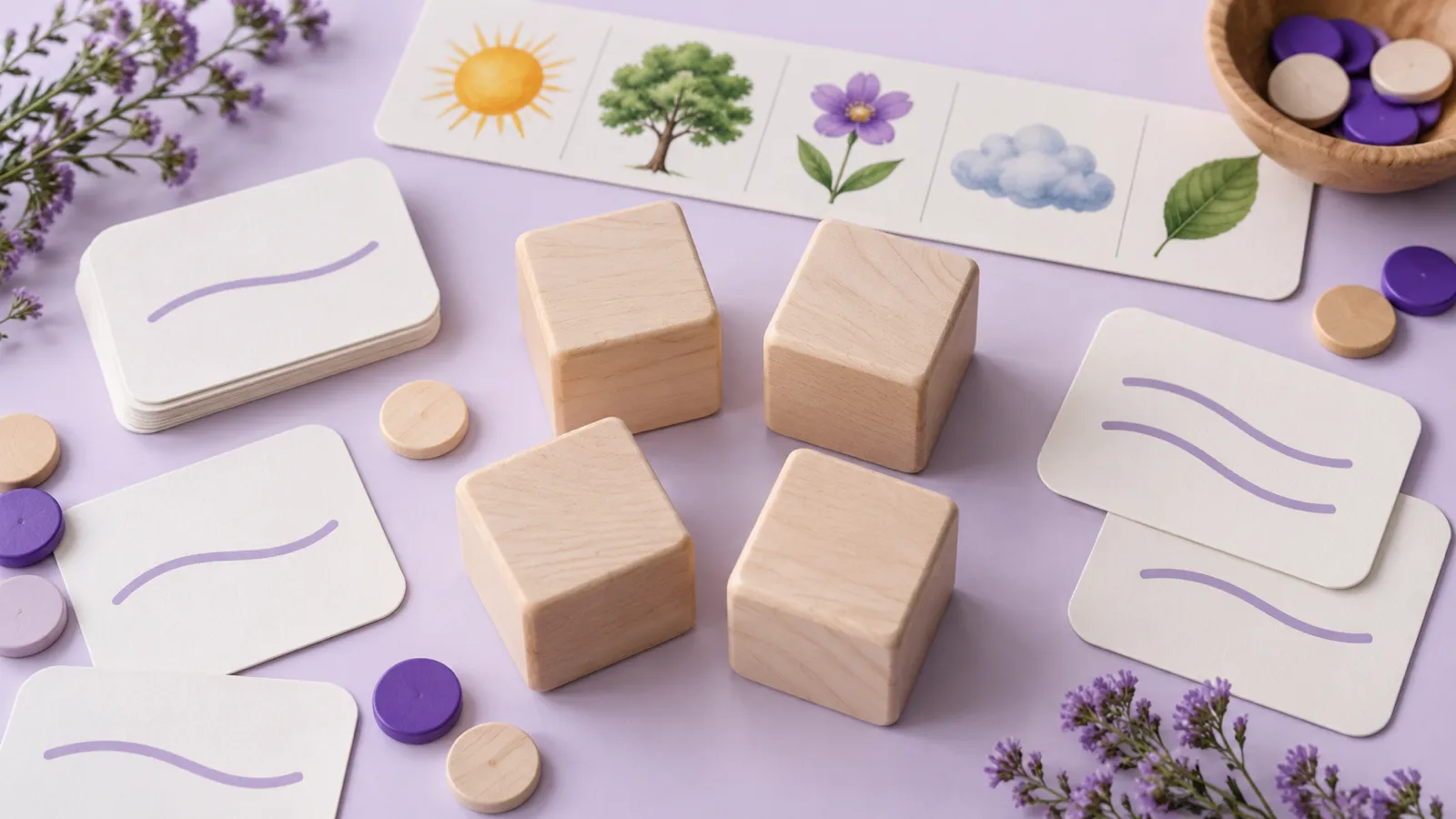
Literacy Centers for 1st Grade: 20 Ideas Aligned with the Science of Reading
First grade literacy centers work best when every station practices a skill you've already taught explicitly: phonemic awareness, phonics patterns, decodable reading, fluency, vocabulary or sentence writing. Swap cute-but-busy tasks (picture sorts by first letter only, word searches, guessing from pictures) for activities where students say sounds, blend, build and read words, and write sentences. Run four or five centers of 12 to 15 minutes while you teach a small group, keep the routines the same all year and change only the content as your phonics sequence moves forward.
In this article you will find
- What makes a center “science of reading” aligned
- Phonemic awareness centers (1–4)
- Phonics and word work centers (5–10)
- Decodable reading and fluency centers (11–14)
- Vocabulary and comprehension centers (15–17)
- Writing centers (18–20)
- A sample weekly rotation
- Setting up centers so they run without you
- Centers that look busy but don’t build reading
- Supporting every learner
- Where centers fit in the literacy block
- Prepare center materials faster
The best 1st grade literacy centers practice skills you’ve already taught explicitly, such as phonemic awareness, phonics patterns, decodable reading, fluency, vocabulary and sentence writing, so that students spend center time saying sounds, blending, building and reading real words instead of coloring or guessing from pictures. Centers give you time to teach small groups, but only if the rest of the class is practicing something useful on their own. Below are 20 center ideas sorted by skill, a sample weekly rotation, tips for keeping centers running smoothly and a quick test for spotting centers that look busy but don’t build reading.
What makes a center “science of reading” aligned
A center is aligned when it meets three conditions:
- It practices something already taught. Centers are for practice, not new learning. If you taught the sh digraph on Monday, the word-building center uses sh words by Wednesday.
- Students connect sounds and letters. They say sounds, blend them, segment words and write the letters. The task can’t be finished by looking at pictures alone.
- Students read and write real text. They read decodable words, phrases and sentences that match the patterns they know.
Quick test: could a student finish this center without reading or saying a single sound? If the answer is yes, change it.
Phonemic awareness centers (1–4)
- Sound boxes. Students pick a picture card, say the word, push one chip into a box for each sound and then say each sound as they touch the box. For extra practice, they write the letters in the boxes.
- Odd one out. Groups of three picture cards where two share a sound (first, middle or last). The partner names the one that doesn’t fit.
- Robot talk. One partner says a word in “robot” (/m/ /a/ /p/), the other blends it and finds the picture.
- Sound swap. Students say a word, change one sound and say the new word: cat to cap to map. They record the chain with letter tiles.
For more oral games, see our blending and segmenting activities.
Phonics and word work centers (5–10)
- Word building with letter tiles. Students build a list of words following your current pattern (ship, shop, fish, wish), read each word and write it.
- Word chains. Change one letter at a time: bat, bit, sit, sip, ship. Students read each new word out loud before writing it.
- Sort by pattern. Word cards sorted by vowel sound or spelling pattern: short a vs long a with silent e, or -ck vs -k. Students read every card as they sort.
- Read and match. Decodable phrases matched to pictures: “a big red hat,” “the fish in a dish.”
- Real or nonsense. Students read words with the current pattern, including some made-up words, and sort them into real and nonsense. This keeps them decoding instead of guessing.
- Dictation partners. One partner reads a word or short sentence from a card; the other writes it, then they check together.
Decodable reading and fluency centers (11–14)
- Decodable book bins. Each group has a bin of decodable texts matched to the patterns they’ve learned. Students read with a partner and mark each book on a log.
- Phrase fluency strips. Short phrases on strips (“in the box,” “up the hill”) read three times, getting smoother each time.
- Partner reading with roles. One reads, one follows along with a finger, then they switch. A simple bookmark reminds them of the jobs.
- Record and listen. Students record themselves reading a familiar decodable passage on a classroom device, listen back and read again.
Vocabulary and comprehension centers (15–17)
- Picture vocabulary sort. Picture cards for words from your read-aloud sorted into categories (things in a habitat, ways to move). Students say a sentence with each word.
- Retell with props. Story pictures or simple props from a read-aloud. Partners retell with first, next, then, last.
- Question cubes. After reading a decodable text, students roll a cube with who, what, where, when, why and how, and answer aloud.
Writing centers (18–20)
- Build a sentence. Word cards (with the current patterns and taught heart words) arranged into sentences, then copied with a capital and a period.
- Picture prompt writing. A photo and a sentence frame: “I see a ___. It is ___.” Students write one or two sentences using sounds they know.
- Fix it up. A sentence with two errors (missing capital, missing period, a misspelled pattern word). Students rewrite it correctly.
A sample weekly rotation
| Group | Day 1 | Day 2 | Day 3 | Day 4 |
|---|---|---|---|---|
| Group A | Teacher table | Word work | Decodable bins | Writing |
| Group B | Word work | Teacher table | Writing | Decodable bins |
| Group C | Decodable bins | Writing | Teacher table | Word work |
| Group D | Writing | Decodable bins | Word work | Teacher table |
Day 5 can be a flexible day: catch-up for groups that missed teacher time, reteach or assessment. Each center lasts 12 to 15 minutes, and students visit two or three a day.
Setting up centers so they run without you
Teach one center a day in August or September. Model it, have a group try it while the class watches and practice cleaning up. Wait until every routine is solid before starting small groups.
Keep routines the same, change the content. Word building always works the same way; only the letters change. That way, students never need you to explain a new task.
Use visual directions. A card with three or four pictures and simple words: get the tiles, build the word, read it, write it.
Give an “I’m done” option. A familiar decodable book bin or a word list to read to a partner keeps early finishers reading.
Set a “can I interrupt?” rule. Students ask three classmates before coming to the teacher table, unless someone is hurt or sick.
Add accountability. A recording sheet, a quick photo of the finished work or a partner sign-off helps you see who practiced and who needs help.
Centers that look busy but don’t build reading
Some popular activities keep students quiet but give little reading practice:
- Word searches (students hunt for letter shapes rather than read).
- Coloring pages with only one letter.
- Cut-and-paste picture sorts where students never read or say a word.
- Leveled books that need guessing from pictures because the words don’t match the patterns students have learned.
You don’t need to throw out everything you have. Often a small change fixes a center: add “read each word to your partner” to a sort, or replace a leveled book with a decodable one.
Supporting every learner
- Students who need more practice: Shorter word lists and the same center for two weeks in a row.
- Students ready for more: Longer words with the same pattern, or writing their own sentences with the pattern words.
- Students learning English: Pictures on vocabulary cards and sentence frames for retelling.
- Students with IEPs or 504 plans: Follow documented accommodations, such as a visual schedule or fewer items, and check with the special education team for any modified tasks.
Where centers fit in the literacy block
Centers are one part of the block, not the main instruction. Whole-group phonics and phonemic awareness lessons come first, and small groups at the teacher table are where you reteach and push forward. For more on running the teacher table, see our guide to small group reading instruction. If you also run math stations, our ideas for kindergarten math centers use the same routines.
Prepare center materials faster
Word lists, sentence cards and decodable phrases for every phonics pattern take hours to make. An AI worksheet tool can draft word-building lists, sentence strips and fix-it sentences for your current pattern, and you review them before printing.
For setup, routines and center ideas across every subject and grade, visit our guide to learning centers.
FAQ
What are literacy centers in 1st grade?
They are short, independent or partner stations where students practice reading and writing skills they've already learned, while the teacher works with a small group. Each center has one clear task and the same routine every week.
How do literacy centers fit the science of reading?
Each center should practice a skill taught explicitly in your phonics and phonemic awareness lessons, with students reading and writing real words. Avoid activities that encourage guessing words from pictures or memorizing words without connecting sounds to letters.
How many centers should I have in 1st grade?
Four or five centers of 12 to 15 minutes each is common. Students visit two or three a day, so every group meets with the teacher daily or almost daily.
How often should I change literacy centers?
Keep the routine of each center the same and change the content every week or two to match your phonics sequence. New routines take time to teach, while new words in a familiar routine don't.
Read next
 Teaching
Learning Stations vs Centers: The Difference, Rotation Schedules and Examples
 Math
Kindergarten Math Centers: 25 Ideas by Skill (Counting, Shapes, Addition)
Literacy
The 5 Components of Reading (the "Big Five") and Where Each Fits in the Science of Reading
Literacy
The Simple View of Reading Explained (the "Science of Reading Formula")