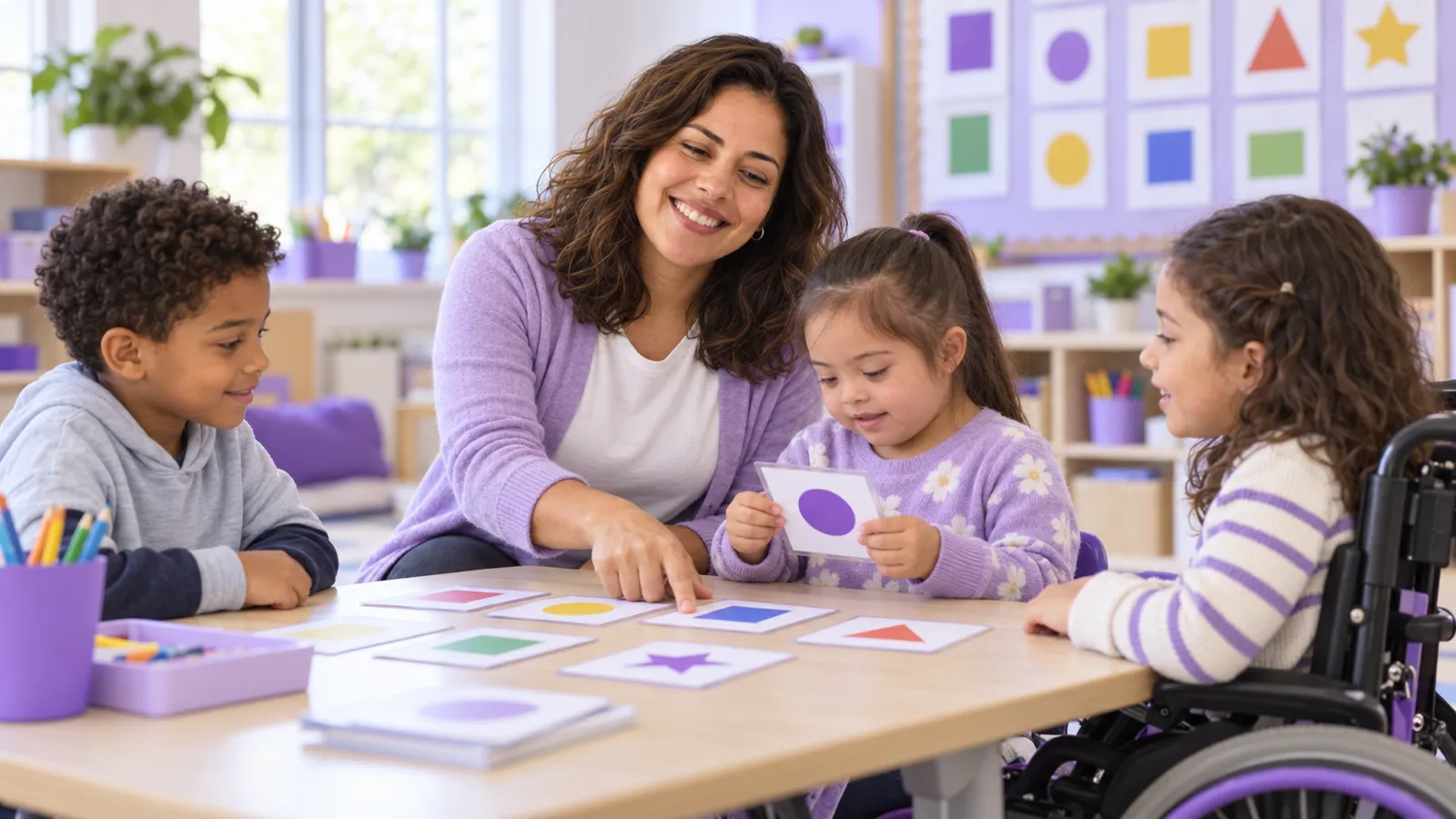
Social Skills IEP Goals: A Goal Bank for Elementary
A good social skills IEP goal names one observable skill (taking turns, starting a conversation, solving a conflict), the setting where it will happen, the level of support, and a criterion you can count. Write it from the student's baseline, teach the skill explicitly, and measure it in real settings like recess and group work, not only in the therapy room.
In this article you will find
A strong social skills IEP goal names one observable skill (like taking turns or joining a conversation), where it will happen, how much support the student gets, and a number you can actually count. Vague goals such as “will improve peer relationships” can’t be measured and don’t tell anyone what to teach. Below you’ll find a goal bank for elementary students organized by skill area, with baselines, data ideas and tips for teaching the skill so it shows up at recess, not just in a small-group room.
The formula for a measurable social skills goal
Every goal in this bank follows the same structure you’d use in any area. If you need a refresher, our guide on how to write IEP goals covers it in detail.
| Part | Question it answers | Example |
|---|---|---|
| Condition | When, where, with what support? | During a structured board game with 2 peers |
| Behavior | What will the student do, in observable terms? | will take turns by waiting for their turn and passing the materials |
| Criterion | How well, how often? | in 4 of 5 opportunities |
| Measurement | How and how often is it checked? | measured by teacher event recording twice weekly |
The single best test: if two adults watched the same 10 minutes, would they agree on whether the student met the goal? If not, tighten the behavior.
Start with the present levels
Social skills goals fall apart when the baseline is a feeling instead of a number. Before writing, collect a few days of data in the settings where the problem shows up:
- Turn-taking: out of 10 turns in a game, how many did the student wait for?
- Joining play: at recess, how many times did the student approach peers, and what happened?
- Conversation: in a 5-minute partner talk, how many back-and-forth exchanges occurred?
- Conflict: over two weeks, how many conflicts happened and how did they end?
A useful present-levels sentence sounds like this: “During structured games, Student waits for their turn in 3 of 10 opportunities and grabs materials in the rest. At recess, Student stands near peers but does not initiate play in 5 of 5 observations.”
Social skills IEP goal bank
Adjust the numbers, settings and supports to your student’s baseline. These are starting points, not finished goals.
Turn-taking and sharing
- During a structured game with 2–3 peers, the student will wait for their turn and pass materials without grabbing in 4 of 5 opportunities across 3 consecutive weeks.
- During center time, the student will share a requested material within 1 minute, with no more than one verbal prompt, in 80% of observed opportunities.
- During a partner activity, the student will use a turn-taking phrase (“Your turn,” “Can I go next?”) in 4 of 5 opportunities, with a visual cue fading to none.
Joining and starting interactions
- During unstructured play, the student will approach a peer or group and use a scripted or self-generated phrase to join (“Can I play?”) in 3 of 4 observed opportunities.
- Upon arrival, the student will greet a peer or adult by name, with eye contact or another culturally appropriate signal, on 4 of 5 school days.
- During lunch, the student will initiate a conversation with a peer on a shared topic at least twice per lunch period across 3 consecutive weeks.
Conversation skills
- During a 5-minute partner conversation, the student will maintain a topic for at least 4 back-and-forth exchanges in 4 of 5 opportunities.
- During small-group discussion, the student will ask a peer a related follow-up question at least once per discussion in 80% of sessions.
- When a peer is speaking, the student will wait until the peer finishes before responding, interrupting no more than once per 10-minute discussion, across 4 of 5 sessions.
Group work and cooperation
- During cooperative learning tasks, the student will complete their assigned role (materials manager, recorder, reporter) for the full task in 4 of 5 group activities.
- When a group decision is needed, the student will accept the group’s choice or suggest a compromise using a sentence starter in 3 of 4 opportunities.
- When losing a game, the student will use an expected response (“Good game,” a handshake, or a calm-down strategy) instead of leaving or yelling in 4 of 5 opportunities.
Conflict resolution and problem-solving
- When a conflict occurs with a peer, the student will name the problem and choose a strategy from a visual menu (talk it out, take turns, get an adult, walk away) in 4 of 5 opportunities.
- After a peer conflict, the student will identify one thing they could do differently next time during a debrief, in 4 of 5 debriefs.
- When upset with a peer, the student will use words to state the problem (“I don’t like it when…”) instead of physical aggression in 90% of opportunities across 6 weeks.
Perspective-taking and reading social cues
- Given a picture or short video scene, the student will identify a character’s feelings and one clue that shows it in 4 of 5 trials.
- During a real classroom situation, the student will name how a peer might feel and why, when asked, in 3 of 4 opportunities.
- When a peer shows signs of disinterest (looking away, changing topic), the student will shift topic or ask a question in 3 of 5 observed opportunities.
If the student also has a diagnosis of autism, combine this bank with our IEP goals for students with autism, which covers communication and self-regulation goals. Goals about aggression or leaving the area may belong with behavior IEP goals and a behavior plan.
How to measure social skills progress without losing your day
Social behavior happens in noisy, fast places. Keep data simple:
- Choose fixed windows. Two 10-minute recess observations per week beat random notes.
- Use event recording. Make a column for each opportunity and code it: I (independent), P (prompted), N (not used).
- Count opportunities, not just successes. “3 times” means little unless you know there were 4 chances, not 20.
- Collect in more than one setting. A skill counted only in the speech room isn’t generalized yet.
- Ask other adults. Recess aides and specials teachers can mark a quick tally card.
| Date | Setting | Opportunities | Independent | Prompted | Not used |
|---|---|---|---|---|---|
| 10/6 | Recess | 4 | 1 | 2 | 1 |
| 10/8 | Center time | 5 | 2 | 2 | 1 |
| 10/13 | Recess | 4 | 2 | 1 | 1 |
Teaching the skill, not just measuring it
A goal is a target. The IEP also needs specially designed instruction to reach it. Effective social skills teaching usually follows this pattern:
- Explain the skill in one sentence and why it matters (“When we take turns, everyone gets to play and friends want to play again”).
- Model it, including a non-example the student can spot.
- Practice with role-play in a calm setting.
- Prompt in the real setting, using a visual card or a quiet cue.
- Fade prompts on a planned schedule.
- Reinforce with specific praise that names the skill.
Short social narratives, video modeling and peer buddies can help, but the team should choose methods that fit the student’s age, language and culture. Avoid goals that require a student to look “typical,” such as forced eye contact. Focus on skills that help the student connect and participate.
Common mistakes
- Too many goals at once. Pick the one or two skills that unlock the most participation.
- Goals that only happen in therapy. Write the real setting into the condition.
- Criteria that are unrealistic. 100% is rarely appropriate for social behavior; adults don’t hit it either.
- No plan for generalization. Name the settings and people in the goal or the services.
A note on privacy and team decisions
Sample goals are drafting language. The IEP team decides which needs to address, writes the final goals and approves services under IDEA and your district’s procedures. Keep observation notes in your school’s official system, use initials in informal tallies, and never enter a student’s name or identifying details into an AI tool.
For more measurable examples in reading, math, writing and behavior, browse the full IEP goal bank.
FAQ
What are examples of social skills IEP goals?
Examples include: during a structured game, the student will take turns with peers without adult prompts in 4 of 5 opportunities; during unstructured play, the student will use a scripted phrase to join a group in 3 of 4 observed opportunities; and when a conflict happens, the student will name the problem and choose a strategy from a visual menu in 4 of 5 opportunities.
How do you measure social skills goals?
Count opportunities and successes. Pick a fixed setting and time (for example, the first 10 minutes of recess on Tuesdays and Thursdays), record each opportunity for the skill, and mark whether the student used it independently, with a prompt, or not at all. Event recording and short interval checks work well.
Should social skills goals be written for kids without autism?
Yes, when the present levels show a social skills need that affects the student's education. Students with ADHD, language disorders, anxiety or other disabilities may also have social skills goals. The IEP team decides based on data, not on the diagnosis alone.
Who works on social skills goals?
Often a team: the special education teacher, the speech-language pathologist (especially for pragmatic language), the school counselor or psychologist, and general education staff who see the student with peers. The IEP lists who is responsible for each goal.
Read next
 Special Education
IEP Goals for ADHD: Attention, Impulsivity and Work Completion Examples
 Special Education
Preschool IEP Goals: Social, Communication, Adaptive and Pre-Academic Examples
Special Education
IEP Goals for Sight Words: 15 Examples and How to Measure Them
Special Education
Functional IEP Goals for Students with Severe and Profound Disabilities
Special Education
504 Plan vs IEP for ADHD: Which One Fits and What Each Includes
Special Education
Accommodations for Anxiety in the Classroom (and During State Tests)