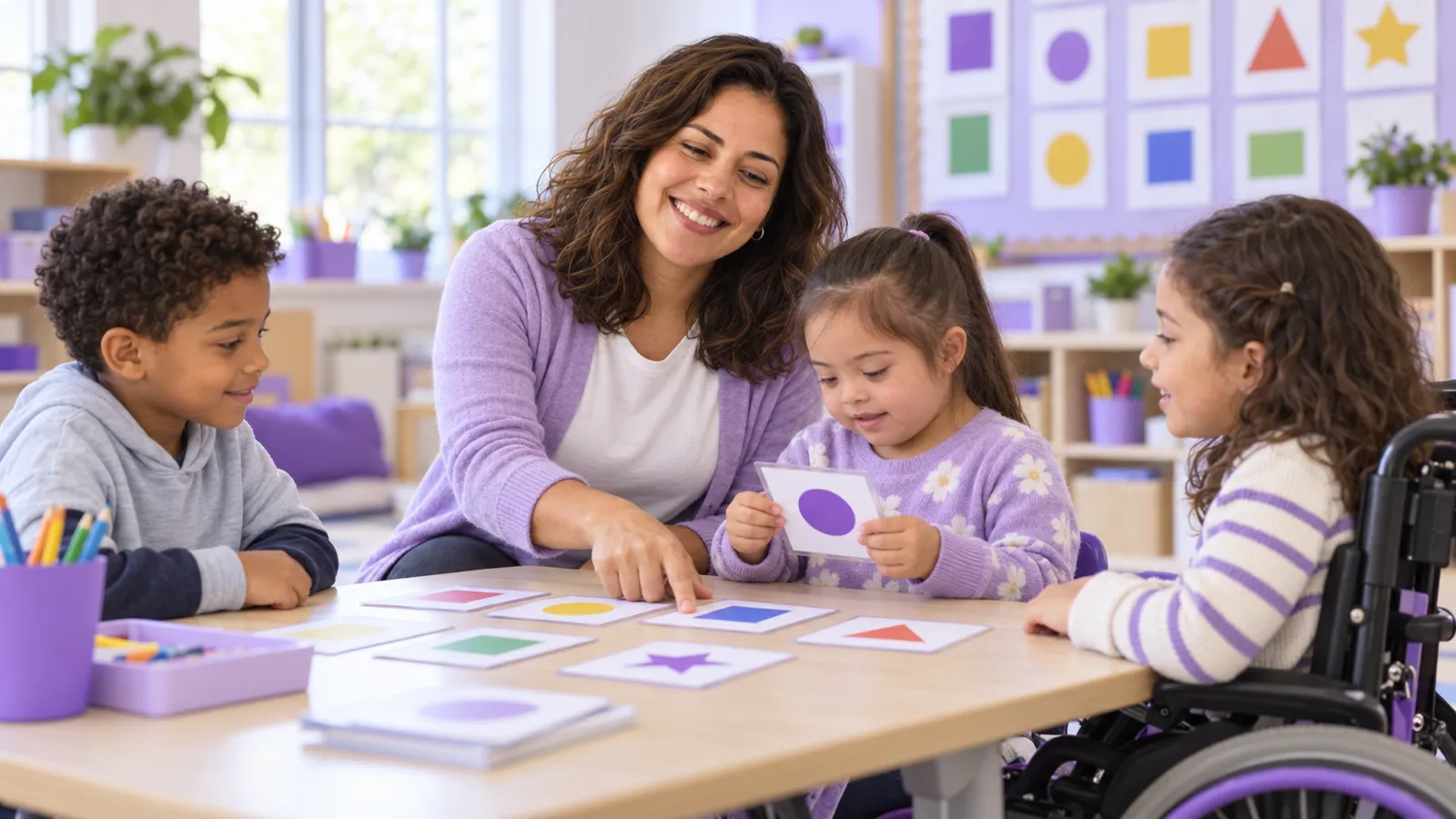
Functional IEP Goals for Students with Severe and Profound Disabilities
Functional IEP goals for students with severe and profound disabilities target skills that increase independence, communication and participation in daily life: making choices and requests, self-care routines, functional reading and math, motor skills, social and leisure participation and community skills. Like any IEP goal, each one needs a baseline from present levels, a specific observable behavior, the conditions and level of support, a measurable criterion and a way to collect data. Goals should be small enough to show progress, meaningful to the student and family, and connected to grade-level content when the team uses alternate achievement standards. The IEP team decides every goal.
In this article you will find
- What makes a goal “functional”
- Measuring progress in small steps
- Communication goals
- Self-care and daily living goals
- Functional academics goals
- Motor and positioning goals
- Social and leisure goals
- Community and vocational goals
- Connecting to grade-level content
- Collecting data
- Involving the family
- Privacy
- Draft goals faster
Functional IEP goals for students with severe and profound disabilities target skills that increase independence, communication and participation in daily life, such as making requests, completing self-care routines, using functional reading and math, moving and positioning, taking part in leisure activities and navigating the community. Each goal still needs the same parts as any IEP goal: a baseline, a specific observable behavior, the conditions and level of support, a measurable criterion and a timeline. This article gives examples for each area, explains how to make small steps of progress measurable and covers how functional goals relate to grade-level content. As always, the IEP team, including the family, decides on every goal. If you need a refresher on the structure, start with our guide on how to write IEP goals.
What makes a goal “functional”
A functional goal answers the question: “Will this skill make a real difference in the student’s life, now and in the future?” Good functional goals are:
- Meaningful: chosen with the family and connected to the student’s daily routines.
- Age-respectful: using materials and activities suited to the student’s age, not much younger children’s.
- Usable across settings: practiced at school, at home and in the community when possible.
- Measurable in small steps: progress can be seen in prompt levels, number of trials or duration.
Measuring progress in small steps
For many students with significant disabilities, progress happens in small increments. These are common ways to measure it:
- Prompt level: from full physical prompt to partial physical, model, gesture, verbal and independent.
- Number of opportunities: for example, 4 out of 5 opportunities.
- Number of steps in a task analysis: for example, 6 of 8 steps of handwashing.
- Duration or latency: for example, stays engaged for 5 minutes, or responds within 10 seconds.
- Settings or people: the skill shows up with two different adults or in two settings.
Baselines come from the present levels. Our present levels of performance examples show how to describe current skills in observable terms.
Communication goals
- Given a choice of two objects or pictures, the student will indicate a preference by reaching, looking or touching for 4 out of 5 opportunities across three consecutive sessions, with no more than a gesture prompt.
- Using a speech-generating device, the student will request a preferred item or activity during snack and leisure routines at least five times per day for 4 consecutive weeks, independently.
- The student will use a “help” or “break” symbol to request assistance or a break, without challenging behavior, in 8 out of 10 opportunities.
- The student will respond to greetings from peers and adults with a wave, vocalization or device message in 4 out of 5 opportunities across settings.
Coordinate communication goals with the speech-language pathologist so everyone uses the same system and vocabulary.
Self-care and daily living goals
- Given a picture task analysis, the student will complete 7 of 9 steps of handwashing with no more than a gesture prompt for 4 out of 5 trials.
- The student will use a spoon to scoop and bring food to the mouth during lunch with partial physical assistance reduced to a light touch, in 80% of bites over two weeks.
- The student will indicate the need to use the restroom using a picture, sign or device message in 3 out of 4 opportunities per day for 10 consecutive school days.
- The student will put on a jacket with a zipper started by an adult, independently, in 4 out of 5 opportunities before outdoor time.
Functional academics goals
Functional reading:
- The student will match 10 functional words or symbols (such as exit, restroom, stop, danger) to pictures with 80% accuracy across three sessions.
- The student will follow a picture or word schedule of five activities, moving to the next activity with no more than a gesture prompt, for 4 out of 5 days.
Functional math:
- The student will count out up to 5 objects to match a number card in 4 out of 5 trials.
- Using a next-dollar strategy, the student will pay for an item costing up to $5 in a school store simulation with 80% accuracy over three sessions.
- The student will identify the time of a daily routine on a visual schedule matched to a clock face (hour) in 4 out of 5 opportunities.
Motor and positioning goals
- The student will maintain upright seated posture with support for 10 minutes during group activities in 4 out of 5 sessions.
- The student will use a switch to activate a device or toy within 10 seconds of a verbal cue in 8 out of 10 opportunities.
- The student will grasp and release objects into a container during a sorting task with partial physical support faded to a gesture, in 4 out of 5 trials.
Motor goals should be developed with the occupational and physical therapists, who often provide the baseline and data methods.
Social and leisure goals
- The student will take part in a turn-taking game with one peer for 3 exchanges with adult support faded to a gesture, in 4 out of 5 opportunities.
- During free time, the student will choose a leisure activity from a choice board and engage with it for 5 minutes in 4 out of 5 sessions.
- The student will stay with a small group during a whole-class activity, such as morning meeting, for 10 minutes with no more than two redirections, in 4 out of 5 days.
Community and vocational goals
- During a community outing, the student will stay with the group and stop at the curb when given a verbal cue in 9 out of 10 opportunities.
- The student will complete a classroom job (such as delivering attendance or sorting recycling) following a 5-step picture task analysis with no more than a gesture prompt in 4 out of 5 days.
- The student will recognize a safety sign and respond appropriately (such as stopping at a “stop” sign) in 4 out of 5 opportunities.
Connecting to grade-level content
Students with the most significant cognitive disabilities may take an alternate assessment based on alternate academic achievement standards. Under the Every Student Succeeds Act, statewide participation in this assessment is capped at 1% of all students assessed in each subject, and the IEP team decides, using state guidelines, whether an individual student participates. Many states expect IEP goals for these students to link to grade-level content in a reduced-complexity form.
In practice, that might look like a 4th grade student working on identifying the main character in an adapted story using pictures while classmates analyze characters in a novel. Balancing these academic links with functional goals is a team decision based on the student’s needs and the family’s priorities.
Collecting data
Functional goals need frequent, simple data. A sheet that tracks the prompt level for each step of a task analysis, or the number of correct responses out of the opportunities offered, is usually enough. Make sure everyone who works with the student, including paraprofessionals, uses the same sheet and the same prompt definitions. Our IEP goal data collection sheets include formats for task analysis and prompt levels.
Involving the family
Ask the family which skills would make the biggest difference at home: communicating hunger or pain, eating independently, tolerating a car seat or bath, joining family activities. These priorities often become the most meaningful goals. Share data in plain language and celebrate small steps; a move from full physical to partial physical support is real progress.
Privacy
IEPs, present levels, data sheets and health information are education records protected under FERPA. Keep them in school-approved systems and share them only with staff who need them.
Draft goals faster
Writing measurable functional goals with clear prompt levels takes time. An AI IEP goal draft assistant can turn your notes on present levels into draft goals with conditions and criteria, and the team reviews, edits and decides on each one.
For goals across reading, math, writing, behavior and more, visit our full IEP goal bank.
FAQ
What are functional IEP goals?
They are goals for skills a student uses in everyday life: communicating wants and needs, eating, dressing, toileting, recognizing safety signs, using money, following a schedule and taking part in school and community routines.
How do you write measurable goals for students with profound disabilities?
Use the same parts as any goal: a baseline, a specific observable behavior, the conditions and prompting level, a measurable criterion and a timeline. Small steps, such as reducing the prompt level or increasing the number of trials, make progress visible.
Should functional goals connect to grade-level standards?
When students participate in alternate assessments based on alternate achievement standards, many states expect IEP goals to link to grade-level content in a reduced-complexity form, alongside functional goals. The IEP team decides how to balance them.
How many goals should a student with severe disabilities have?
There's no set number. Teams usually focus on a manageable set of high-priority goals across key areas so each can be taught and measured often.
Read next
 Special Education
IEP Goals for ADHD: Attention, Impulsivity and Work Completion Examples
 Special Education
Preschool IEP Goals: Social, Communication, Adaptive and Pre-Academic Examples
Special Education
IEP Goals for Sight Words: 15 Examples and How to Measure Them
Special Education
Kindergarten IEP Goals: Reading, Math, Writing and Behavior Examples
Special Education
504 Plan vs IEP for ADHD: Which One Fits and What Each Includes
Special Education
Accommodations for Anxiety in the Classroom (and During State Tests)