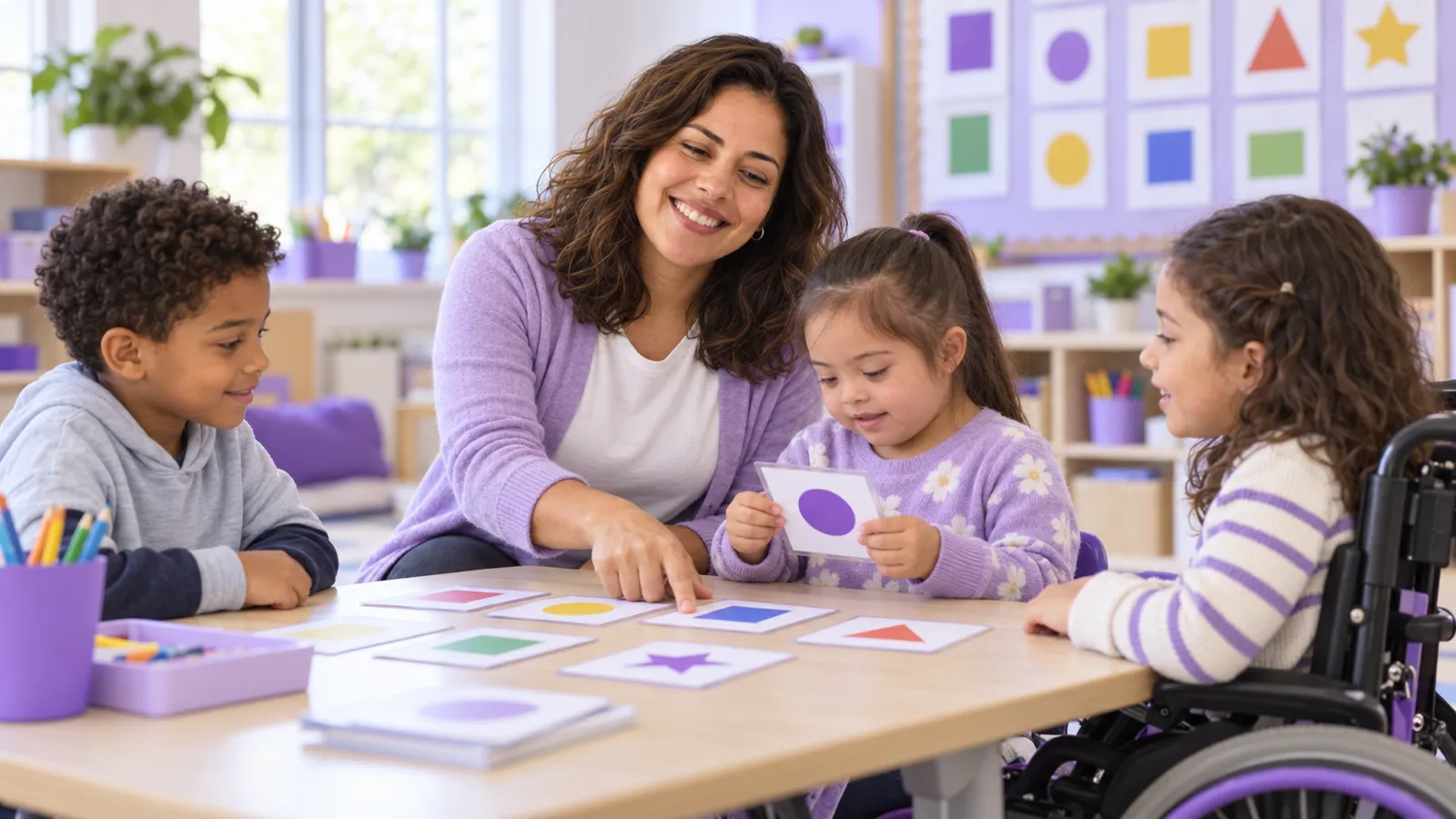
Social-Emotional IEP Goals: Self-Regulation, Coping and Emotional Identification
Social-emotional IEP goals target how a student recognizes and manages emotions: identifying feelings in themselves, noticing early body signals, using a coping strategy, tolerating frustration, recovering after being upset and asking for help or a break. Good goals describe an observable behavior (for example, 'will use a taught coping strategy within 2 minutes of a frustrating event'), the setting, the level of support and a criterion. They're different from social skills goals, which focus on interaction with peers. All goals are decided by the IEP team, often with the school counselor or psychologist.
In this article you will find
- Social-emotional vs social skills vs behavior goals
- A goal formula
- Emotional identification goals
- Body awareness and early warning signs
- Self-regulation and coping goals
- Frustration tolerance and persistence
- Self-advocacy and help-seeking
- Writing goals by age
- Collecting data
- Teaching the skills in the classroom
- Common mistakes to avoid
- Prep in less time
Social-emotional IEP goals target how a student recognizes and manages their own emotions: identifying feelings, noticing early body signals, using a coping strategy, tolerating frustration, recovering after being upset and asking for help or a break appropriately, and each goal names an observable behavior, the setting, the level of support and a measurable criterion. These goals are different from social skills goals, which focus on interactions with peers like taking turns or holding a conversation. A student who melts down when work gets hard, shuts down when corrected or can’t name what they’re feeling may need goals in this area. Below you’ll find a goal formula, examples by skill area for K–5, how to collect data and how to teach the skills in the classroom. Every goal shown is an example; the IEP team decides the actual goals for each student. For more areas, see our IEP goal bank.
Social-emotional vs social skills vs behavior goals
| Goal type | Focus | Example skill |
|---|---|---|
| Social-emotional | The student’s own feelings and regulation | Uses a coping strategy when frustrated |
| Social skills | Interacting with others | Takes turns in a conversation |
| Behavior | Reducing a specific behavior and replacing it | Requests a break instead of leaving the room |
The three often overlap. A behavior goal may be based on a functional behavior assessment, and our IEP goals for behavior post covers that area. Social-emotional goals usually build the underlying skill that makes the behavior goal possible.
A goal formula
When [situation or trigger], [student] will [observable skill] with [level of support] in [criterion], as measured by [method].
Example: When presented with a challenging task, the student will use a taught coping strategy (deep breathing, a break card, asking for help) within 2 minutes, with no more than one visual prompt, in 4 out of 5 observed opportunities across 3 consecutive weeks, as measured by teacher data.
Avoid goals like “will manage emotions” or “will be less anxious.” They can’t be observed or counted.
Emotional identification goals
These are often the starting point, especially for younger students.
- Given pictures of faces, the student will identify 6 emotions (happy, sad, angry, scared, surprised, calm) with 80% accuracy across 3 sessions.
- When asked during a calm check-in, the student will identify their current feeling using a feelings chart or words in 4 of 5 daily check-ins.
- When given a short scenario, the student will name how a character might feel and give one reason in 4 of 5 trials.
- The student will rate the intensity of their feeling on a 1–5 scale during check-ins, matching adult observation in 4 of 5 opportunities.
Body awareness and early warning signs
- Using a body map, the student will identify 2 personal physical signs of frustration or anxiety (for example, tight fists or a fast heartbeat) in 3 of 4 sessions.
- When showing early signs of frustration, the student will name the feeling or point to the feelings chart with one adult prompt in 4 of 5 observed opportunities.
Self-regulation and coping goals
- When upset, the student will choose and use one of 3 taught coping strategies with no more than one prompt in 4 of 5 observed opportunities.
- When frustrated, the student will request a break using words or a break card instead of leaving the area in 4 of 5 opportunities.
- After a break of up to 5 minutes, the student will return to the assigned task within 1 minute of the timer ending in 4 of 5 opportunities.
- When given corrective feedback, the student will respond with a calm body and voice and attempt the correction in 3 of 4 opportunities.
- When a preferred activity ends, the student will transition to the next activity within 2 minutes using a visual timer and first-then board in 4 of 5 transitions.
Calm-down spaces support these goals when they’re taught and used consistently; our calm down corner ideas show how to set one up.
Frustration tolerance and persistence
- When working on a non-preferred or difficult task, the student will continue working for 10 minutes before requesting help or a break in 4 of 5 opportunities.
- When making a mistake, the student will use a self-talk statement (“Mistakes help me learn”) and try again in 3 of 4 observed opportunities.
- When losing a game or not being chosen first, the student will respond with an expected behavior (saying “Good game,” staying in the group) in 4 of 5 opportunities.
Self-advocacy and help-seeking
- When unsure how to complete a task, the student will ask for help using a taught phrase or signal within 3 minutes in 4 of 5 opportunities.
- The student will identify one strategy that helps them feel calm and explain when to use it, in 4 of 5 weekly check-ins with the counselor.
- Before a known stressful event (test, assembly, change in schedule), the student will review a coping plan with an adult and identify one strategy to use, in 4 of 5 opportunities.
Writing goals by age
For K–2, keep goals concrete: naming basic emotions, using one or two strategies with visual supports and accepting adult prompts. For 3–5, goals can target more independent regulation, wider emotion vocabulary, rating intensity and self-advocacy. In both cases, base the goal on the student’s present levels: what they can do now, in which situations, with how much support.
Collecting data
Social-emotional data must be quick to collect during real moments:
- Frequency: how often the student uses a strategy or requests a break appropriately.
- Latency: how long it takes to start using a strategy or return to work.
- Duration: how long an episode of distress lasts.
- Prompt level: how much help was needed.
- ABC notes: antecedent, behavior, consequence for patterns.
Agree with the team on who collects data and when. A simple tally sheet on a clipboard works. Data are confidential education records under FERPA; store and share them according to your school’s policy.
Teaching the skills in the classroom
Goals only work if the skill is taught. In the general education classroom:
- Teach strategies when the student is calm. Practice breathing, break cards and help signals before they’re needed.
- Use visuals. Feelings charts, a coping strategy menu and first-then boards help students choose under stress.
- Prompt early. Notice the warning signs and offer a strategy before frustration peaks.
- Praise specifically. “You used your break card and came back ready to work. That’s exactly the plan.”
- Coordinate with services. If the IEP includes counseling, ask the counselor which language and strategies they use so you can match them.
Whole-class social-emotional learning supports everyone, including students with goals. Our social-emotional learning activities post offers routines organized by competency.
Common mistakes to avoid
- Vague goals. “Will regulate emotions” can’t be measured.
- Goals that target only stopping a behavior. Always include what the student will do instead.
- No teaching plan. A goal without instruction rarely gets met.
- Data only during crises. Measure success too, not just meltdowns.
Prep in less time
Writing a coherent set of goals across identification, coping and self-advocacy takes time. An AI IEP draft assistant can suggest measurable goal wording from a skill area and a situation, which the team reviews, adapts and decides on. Never enter student names or identifiable information into the tool.
Strong social-emotional goals give students the tools to stay regulated and engaged in learning. For goals in reading, math, behavior and more, browse our IEP goal bank.
FAQ
What are social-emotional IEP goals?
They are measurable goals that target emotional skills such as identifying feelings, regulating emotions, using coping strategies, tolerating frustration and asking for help appropriately. They support a student's ability to participate in learning.
What is the difference between social-emotional goals and social skills goals?
Social-emotional goals focus on a student's own emotions and regulation. Social skills goals focus on interaction with others, such as turn-taking, conversation and joining play. Many students have both.
How do you measure emotional regulation in an IEP goal?
Measure observable behaviors: how often the student uses a coping strategy when upset, how long it takes to return to the task, the level of prompting needed or how often the student requests a break appropriately. Avoid vague terms like 'will manage emotions.'
Who writes social-emotional IEP goals?
The IEP team, which may include the special education teacher, general education teacher, school counselor or psychologist, parents and the student when appropriate.
Read next
 Special Education
IEP Goals for ADHD: Attention, Impulsivity and Work Completion Examples
 Special Education
Preschool IEP Goals: Social, Communication, Adaptive and Pre-Academic Examples
Special Education
IEP Goals for Sight Words: 15 Examples and How to Measure Them
Special Education
Functional IEP Goals for Students with Severe and Profound Disabilities
Special Education
504 Plan vs IEP for ADHD: Which One Fits and What Each Includes
Special Education
Accommodations for Anxiety in the Classroom (and During State Tests)