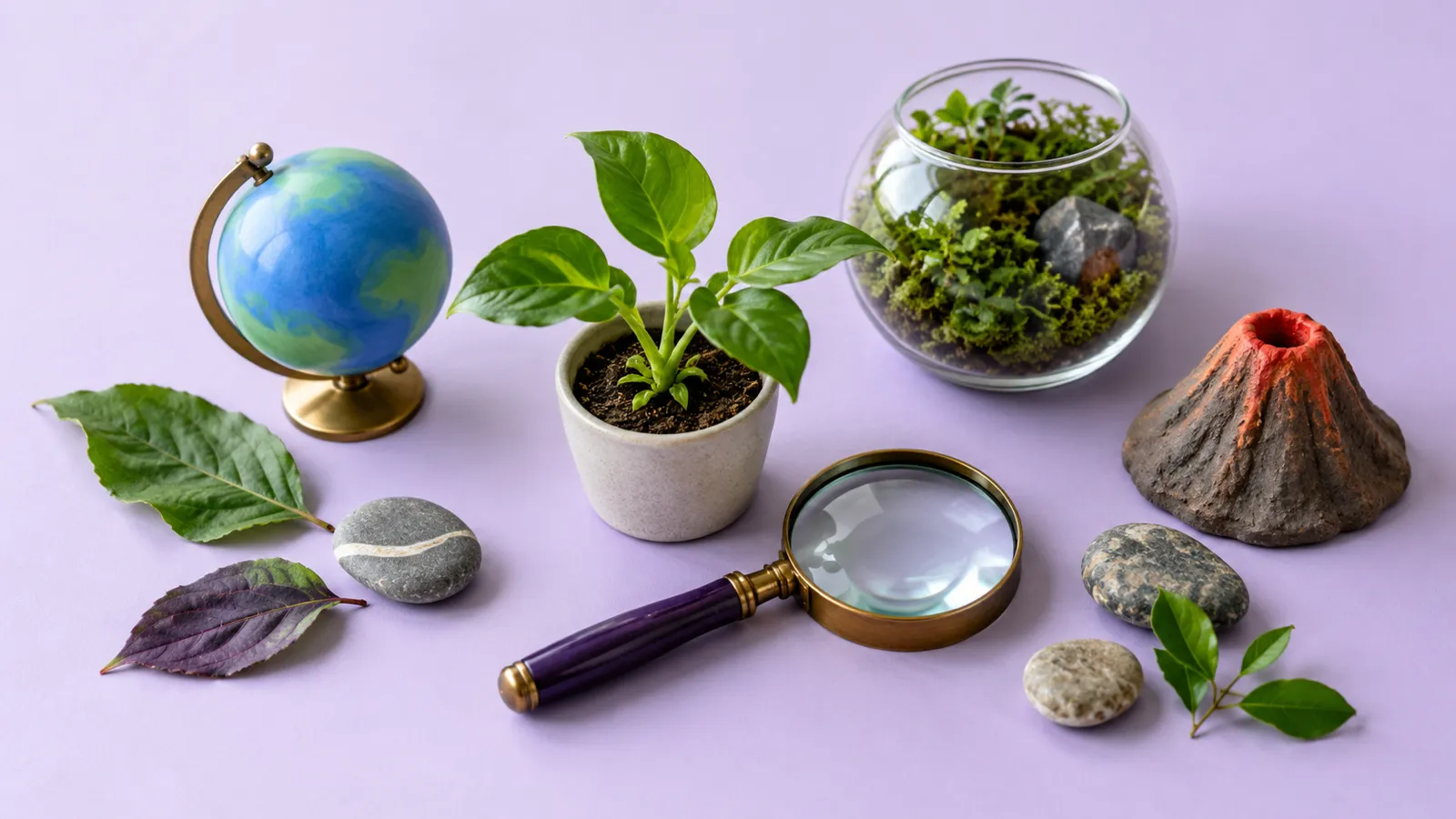
NGSS Phenomena for Elementary: 30 Anchoring Phenomena by Grade
A phenomenon is an observable event in the natural or designed world that students can explain using science ideas. An anchoring phenomenon drives a whole unit: students observe it on day one, ask questions about it and build an explanation over several lessons. Good elementary phenomena are concrete, a little puzzling, connected to students' lives and explainable with grade-level ideas. Below are 30 phenomena, five for each grade from kindergarten to 5th, matched to the standard topics they fit, plus a simple routine for launching a unit with one.
In this article you will find
An NGSS phenomenon is an observable event that students can explain with science ideas, and an anchoring phenomenon is one that drives a whole unit: students observe it on the first day, ask questions about it and build an explanation over many lessons. Phenomena replace the old approach of starting with vocabulary and facts. Instead, students start with something they can see and wonder about, and the learning grows from their questions. Below are 30 anchoring phenomena for elementary school, five for each grade from kindergarten to 5th, matched to the standard topics they fit, along with tips for choosing your own and launching a unit.
What makes a good phenomenon
A strong phenomenon for elementary students usually has these qualities:
- Observable. Students can see it in person, in a short video or in clear photos.
- Puzzling enough. Students can’t fully explain it on day one, so they have a reason to investigate.
- Connected to their lives. It happens in their neighborhood, their home or their school, or it’s something they’ve seen.
- Explainable at grade level. The explanation uses the ideas in the grade’s standards, not advanced science.
- Rich. It leads to many questions, enough to fill a unit.
A phenomenon is not a topic. “Plants” is a topic. “The bean plant on our windowsill bent toward the glass” is a phenomenon.
Kindergarten
- A ball rolls farther on the hallway floor than on the carpet. (Pushes and pulls.) Students test how surfaces and strength of a push change the motion.
- The playground slide is hot in the afternoon but cool in the morning. (Sunlight and warming.) Students compare surfaces in sun and shade and design a shade structure.
- A squirrel buries acorns in the schoolyard. (Animal needs.) Students explore what animals need to survive and how they change their environment.
- The puddles from yesterday’s rain are gone. (Weather.) Students observe and record local weather over time.
- A worm comes out on the sidewalk after rain. (Living things and their environment.) Students explore where plants and animals live and why.
1st grade
- A shadow puppet’s shadow gets bigger when it’s closer to the light. (Light.) Students test how light and objects create shadows.
- A plastic cup “telephone” carries a whisper. (Sound and vibration.) Students investigate how vibrating materials make sound.
- Baby ducks look like their parents but not exactly the same. (Inheritance of traits.) Students compare young animals and plants with their parents.
- A turtle tucks its head into its shell when touched. (Structure and function.) Students explore how animal and plant parts help them survive, and design a solution inspired by nature.
- The moon looks different from one week to the next. (Patterns in the sky.) Students observe and record the moon and sunrise or sunset times.
2nd grade
- Ice pops melt in the lunchbox, but melted chocolate hardens again in the fridge. (Properties and changes of matter.) Students classify materials and test which changes can be reversed.
- A bean seed sprouts in a wet paper towel but not in a dry one. (Plant needs.) Students investigate what plants need to grow.
- Seeds stick to a dog’s fur after a walk. (Seed dispersal.) Students design a model that mimics how animals spread seeds.
- The hill behind the school has a deep gully after a storm. (Earth’s surface changes.) Students explore how wind and water shape land and compare solutions to slow erosion.
- Different animals live in the pond than in the field next to it. (Biodiversity.) Students compare the variety of life in different habitats.
3rd grade
- A magnet picks up paper clips through a book. (Magnetic forces.) Students investigate forces that act without touching and design a simple magnet-based solution.
- A monarch butterfly comes from a caterpillar. (Life cycles.) Students compare life cycles of different organisms.
- Two puppies from the same litter have different coat colors. (Inheritance and variation.) Students use evidence to explain that traits are inherited and vary.
- Our town floods every few springs. (Weather and climate hazards.) Students use weather data and evaluate designs that reduce flood damage.
- Fossils of sea shells are found far from any ocean. (Fossils and past environments.) Students use fossils as evidence of environments long ago.
4th grade
- A rubber band launches a toy car farther when it’s stretched more. (Energy and motion.) Students explain how energy relates to speed and transfer.
- A wave at the beach can knock you over, but it doesn’t carry you away. (Waves.) Students model waves and how they move objects.
- We see the cat in a dark room only when a light is on. (Light and vision.) Students model how light reflects from objects into the eye.
- Rock layers on a canyon wall look like stripes. (Earth’s history.) Students use rock layers and fossils to explain changes in landscapes over time.
- An owl can turn its head almost all the way around. (Structures and senses.) Students argue from evidence how internal and external structures support survival.
5th grade
- Sugar disappears when stirred into water, but the water tastes sweet. (Particles of matter.) Students model matter as tiny particles too small to see.
- Dropped objects always fall down, even on the other side of the world. (Gravity.) Students support the claim that gravity pulls objects toward Earth’s center.
- A plant grows heavier, but the soil in the pot barely changes. (Plant growth.) Students investigate where plants get the materials they need to grow.
- The sun and the moon look about the same size in the sky, even though the sun is far bigger. (Stars and patterns in the sky.) Students explain how distance affects apparent size and brightness, and graph shadow lengths over a day.
- Our school’s recycling bins fill up every week. (Human impact on Earth’s systems.) Students research how communities protect resources and the environment.
These topics follow the K–5 performance expectations in the NGSS. If your state uses its own science standards, the topics are usually very similar; check your state’s version for exact wording.
Launching a unit with an anchoring phenomenon
Here’s a simple routine for day one:
- Show the phenomenon. A short video, a live demonstration or photos. Let students observe without explanation.
- Notice and wonder. Students list what they notice, then what they wonder. Accept every question.
- Initial models. Students draw or write their first explanation. These first ideas are valuable; keep them.
- Build a driving question board. Sort the class questions into groups and post them on a wall. These become the roadmap for the unit.
- Plan investigations. Ask, “What could we do to figure this out?”
At the end of the unit, students return to their initial models and revise them with everything they learned. That before-and-after comparison is powerful evidence of learning.
Investigative phenomena inside the unit
An anchoring phenomenon is usually too big to explain in one lesson. Break it into smaller, investigative phenomena that each explain part of the anchor. For the 5th grade plant phenomenon (number 28), smaller phenomena might be “a plant in a sealed bag gets droplets on the inside” and “a plant kept in the dark turns pale.” Each one gets its own lesson, often using the 5E lesson plan model, and each adds a piece to the explanation.
Connecting phenomena to the three dimensions
A good phenomenon gives students a reason to use all three dimensions of the standards: the science and engineering practices (asking questions, investigating, arguing from evidence), the disciplinary core ideas (the science content) and the crosscutting concepts (patterns, cause and effect, systems and more). When you plan, name which practices and crosscutting concepts the phenomenon naturally invites. Our guides to NGSS crosscutting concepts and science and engineering practices give examples for each grade.
Finding your own phenomena
The best phenomena often come from your own school and neighborhood: the puddle that never dries on the playground, the tree that loses its leaves first, the classroom window that fogs up in winter. Keep a phone album of things you notice and ask students what they wonder about outside. Local phenomena are more engaging and easier for students to observe again and again.
Plan phenomenon-based units faster
Building a unit around a phenomenon, with questions, investigations and lessons, takes time. An AI lesson plan tool can draft a sequence of lessons from a phenomenon and a standard, and you choose which investigations fit your materials and students.
Phenomena are at the heart of NGSS-style science. For the full picture of standards, practices and crosscutting concepts across K–5, visit our guide to NGSS science standards.
FAQ
What is a phenomenon in NGSS?
It's an observable event that students can use science ideas to explain or engineering ideas to solve, like a puddle disappearing, a plant bending toward a window or a ball rolling farther on one surface than another.
What's the difference between an anchoring and an investigative phenomenon?
An anchoring phenomenon drives a whole unit and takes many lessons to explain. Investigative phenomena are smaller events used in single lessons that help students explain part of the anchor.
What makes a good phenomenon for elementary students?
It's observable (ideally in person or on video), a little surprising, connected to students' experiences and explainable with the science ideas in the grade-level standards.
Does a phenomenon have to be surprising?
Not always. Everyday events work well too, as long as students can't fully explain them yet and they lead to questions worth investigating.
Read next
Science
The 5E Lesson Plan Model: Template and a K–5 Science Example
 Science
NGSS Crosscutting Concepts: The 7 Concepts with K–5 Examples
Science
The 8 NGSS Science and Engineering Practices, Explained for K–5
 Literacy
 Centers for 1st Grade: 20 Ideas Aligned with the Science of Reading
Literacy
The 5 Components of Reading (the "Big Five") and Where Each Fits in the Science of Reading