Pre-K Report Card Comments by Domain (Social, Language, Motor, Early Math)
Pre-K comments should describe development, not grades. Organize them by domain (social-emotional, language and literacy, early math, fine and gross motor, approaches to learning), describe what the child does in play and routines, and use 'is beginning to,' 'with support' and 'independently' to show where the child is. Always pair a growing skill with a playful home idea.
In this article you will find
Pre-K report card comments work best when they’re organized by developmental domain (social-emotional, language and literacy, early math, motor and approaches to learning) and describe what the child actually does during play and routines, with words like “is beginning to,” “with support” and “independently” to show where the child is on the path. Four-year-olds develop at very different rates, and families are often reading their child’s first school report. A comment that paints a clear picture of the child at play, names the skill it shows and offers a playful idea for home is far more useful than a checkmark. Below are 70+ comments organized by domain, plus tips for writing about children who are still developing a skill.
How pre-K reporting is different
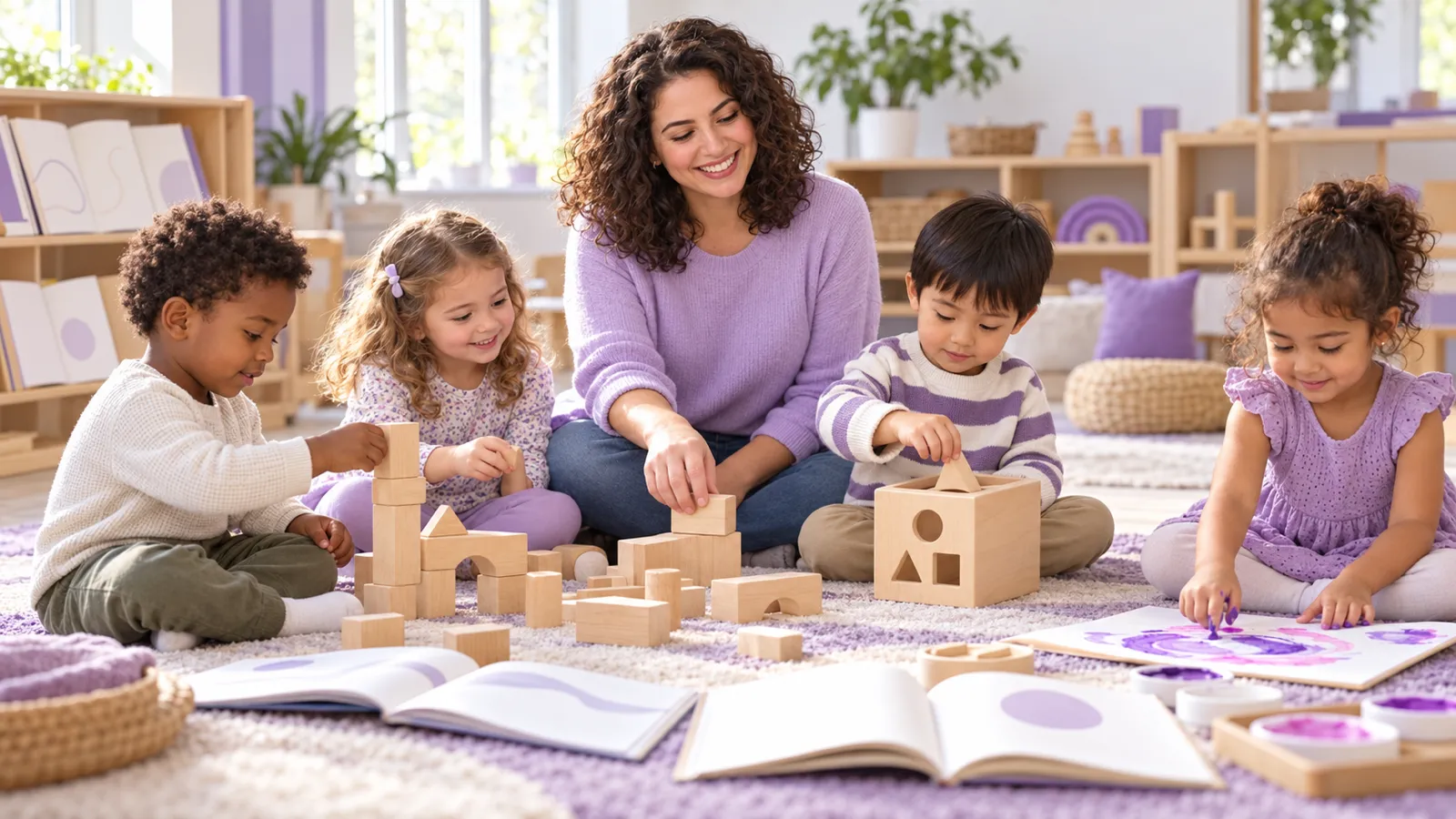
Pre-K report cards are developmental. Instead of grades, most programs use a scale such as “not yet,” “emerging,” “developing” and “proficient,” linked to the state’s early learning standards. Your evidence comes from observation during play, centers, circle time, meals and outdoor time, not from tests. Good comments reflect that: they describe a moment (“While building a tower in the block area, [Name] counted 8 blocks…”) and connect it to a skill.
Be generous with growth language. A child who couldn’t hold a crayon in September and now draws circles has made real progress, even if they’re still “emerging” on the scale.
Key words for levels
| Level | Useful phrases |
|---|---|
| Not yet / beginning | is beginning to, is showing interest in, with hand-over-hand support |
| Emerging | with support, with reminders, sometimes, is starting to |
| Developing | often, with occasional reminders, in familiar situations |
| Proficient | independently, consistently, in new situations, teaches others |
Social-emotional development (1–16)
Social-emotional skills are the heart of pre-K. Comment on relationships, emotions, self-regulation and routines.
- [Name] separates from family calmly in the morning and joins activities right away.
- [Name] plays cooperatively with friends and takes turns with favorite toys.
- [Name] names feelings such as happy, sad, mad and scared, and is beginning to say why.
- [Name] uses words to ask for a turn instead of grabbing.
- [Name] comforts friends who are upset, showing growing empathy.
- [Name] follows our daily routines and knows what comes next.
- [Name] cleans up toys with the group and takes pride in helping.
- [Name] is beginning to use calming strategies like deep breaths with an adult’s support.
- [Name] is learning to share materials during center time.
- [Name] is building friendships and often plays with [one or two friends].
- [Name] is learning to wait for a turn during games and circle time.
- [Name] is starting to use words to solve small conflicts, with a teacher nearby.
- [Name] is learning to transition between activities; a picture schedule helps.
- [Name] is becoming more comfortable joining group activities.
- [Name] asks adults for help when needed.
- At home, naming feelings during story time (“How do you think the bear feels?”) will build this skill.
Language and literacy (17–34)
Comment on listening, speaking, vocabulary, book knowledge, phonological awareness, letter knowledge and early writing.
- [Name] listens carefully during stories and answers questions about them.
- [Name] speaks in complete sentences and shares ideas with the group.
- [Name] uses new words from our read-alouds in conversation.
- [Name] retells familiar stories using pictures and props.
- [Name] holds a book correctly and turns pages one at a time.
- [Name] recognizes [his/her/their] name in print and points out letters from it.
- [Name] identifies [number] uppercase letters and is learning more each week.
- [Name] hears rhymes and can tell whether two words rhyme.
- [Name] claps the syllables in names and familiar words.
- [Name] is beginning to hear the first sound in words, like /m/ in moon.
- [Name] writes the first letter of [his/her/their] name and is working on the rest.
- [Name] uses scribbles, shapes and letter-like marks to “write” messages and lists.
- [Name] is beginning to answer simple questions about a story.
- [Name] is building vocabulary and benefits from talking about pictures together.
- [Name] is learning to wait and listen while others speak in a group.
- Singing rhyming songs and nursery rhymes at home will support [Name]’s listening skills.
- Pointing out letters on signs and cereal boxes makes letter learning fun.
- Reading together every day and asking “What do you think will happen?” builds language.
When children are ready for more sound play, our phonemic awareness activities for kindergarten include games that work well at the end of pre-K.
Early math (35–48)
Comment on counting, number sense, shapes, patterns, sorting and measurement.
- [Name] counts to [20] in order and is learning to count objects one by one.
- [Name] counts groups of up to [10] objects and tells “how many.”
- [Name] recognizes numerals 1 to [10].
- [Name] compares groups and uses words like more, fewer and the same.
- [Name] names basic shapes (circle, square, triangle, rectangle) and finds them in the room.
- [Name] sorts objects by color, size and shape and explains the sort.
- [Name] copies and extends simple patterns such as red, blue, red, blue.
- [Name] uses words like bigger, smaller, longer and shorter when comparing.
- [Name] is beginning to touch each object once while counting.
- [Name] is learning to recognize numerals and enjoys finding them around the room.
- [Name] is starting to notice patterns in songs, movements and blocks.
- [Name] is learning shape names through our block and art centers.
- Counting stairs, snacks or toys together at home builds number sense.
- Setting the table (one plate for each person) is a great math activity.
Physical development: fine and gross motor (49–60)
Fine motor 49. [Name] holds a crayon or marker with a growing pencil grip. 50. [Name] uses scissors to cut along a straight line. 51. [Name] draws people with a head, body and some details. 52. [Name] manages buttons and zippers with little help. 53. [Name] is building hand strength through play dough, tongs and puzzles. 54. [Name] is learning to hold scissors correctly and snip paper. 55. Play dough, stringing beads and tearing paper at home will strengthen small muscles.
Gross motor 56. [Name] runs, jumps and climbs with confidence on the playground. 57. [Name] throws and catches a large ball. 58. [Name] hops on one foot and is learning to skip. 59. [Name] is building balance and coordination during outdoor play. 60. [Name] is learning to pedal a tricycle and navigate around others.
Approaches to learning (61–72)
These comments describe curiosity, persistence, attention and creativity.
- [Name] is curious and asks many “why” and “how” questions.
- [Name] sticks with a puzzle or task even when it is challenging.
- [Name] tries new activities and materials eagerly.
- [Name] uses imagination in dramatic play, creating stories and roles.
- [Name] focuses on a chosen activity for [10 to 15] minutes.
- [Name] solves problems creatively, like finding a new way to build a ramp.
- [Name] shows pride in finished work and likes to share it.
- [Name] is learning to keep trying when something doesn’t work the first time.
- [Name] is building attention during group activities and participates more each week.
- [Name] is beginning to try new materials with encouragement.
- [Name] is learning to finish one activity before starting another.
- Giving [Name] simple choices and small jobs at home builds independence.
Tips for writing about children who are still developing
Four-year-olds vary widely, and a child who is behind in October may catch up by spring. Describe what the child can do now, show what comes next, and say how you’re supporting it. Never compare a child to classmates or older siblings. If you have a real developmental concern, such as speech that’s hard to understand or very limited play with peers, talk with the family in person and follow your program’s process for screening or referral; any evaluation and decisions about services belong to the appropriate team, not the report card.
Keep confidential information, including any existing services or plans, out of the comment, consistent with FERPA and your program’s policies.
Moving up to kindergarten
At the end of the year, many families want to know if their child is ready for kindergarten. Use the final comments to summarize growth across domains and highlight one or two summer activities. Our kindergarten report card comments show what teachers will be looking for next year, and our parent-teacher conference comments help you prepare for the conversation.
For report card comments by grade and subject, plus a calendar of report card seasons, visit the full bank of report card comments.
FAQ
What should a pre-K report card comment include?
An observation from play or routines, the developmental skill it shows, and a simple next step or home activity. For example: '[Name] now writes the first letter of [his/her/their] name on artwork. We are working on the next letters. Writing names in shaving cream or sand at home makes great practice.'
What are the main domains on a pre-K report card?
Most programs use social-emotional development, language and literacy, mathematics, physical development (fine and gross motor), approaches to learning, and sometimes science, social studies and the arts. Follow your state's early learning standards.
How do I describe a pre-K child who is not meeting expectations?
Describe what the child can do now, use 'is beginning to' or 'with support,' and explain how you're helping. Development varies widely at four, so avoid comparisons, and talk with the family in person if you have a real concern.
Should pre-K report cards use grades?
Usually not. Most use a developmental scale such as 'not yet, emerging, developing, proficient,' with comments that describe growth.
Read next
 Assessment
Math Report Card Comments for Elementary (Including Struggling Students)
 Assessment
Behavior Report Card Comments: Positive, Needs Improvement and Next Steps
 Assessment
End of Year Report Card Comments: K–5 Examples for the Final Report
Assessment
1st Grade Report Card Comments (80+ Examples by Subject)
Math
3rd Grade Common Core Math Standards Explained (3.OA, 3.NF, 3.MD) with Examples
 Math
Division Anchor Charts: Vocabulary, Strategies and Long Division (3rd–5th)